Thoughts

What's on my desk?

The idea for this post has been sitting among my drafts for a long time. I always thought it’d be a good idea to share how I work and what equipment I use, for the benefit of those of you that want to put together a similar setup. Let me make it clear that I’m not doing this to brag. I realize my equipment is fairly expensive and out of reach for some. Believe me, I’m keenly aware of its cost, and have made certain sacrifices in order to acquire it.

The hardware I have now is the best hardware I’ve had so far, and it allows me to easily develop for my clients, write for my sites, process my photographs and edit my videos and movies. See the photo enclosed below. Each important piece of equipment is marked with a number, and each number is explained in detail.
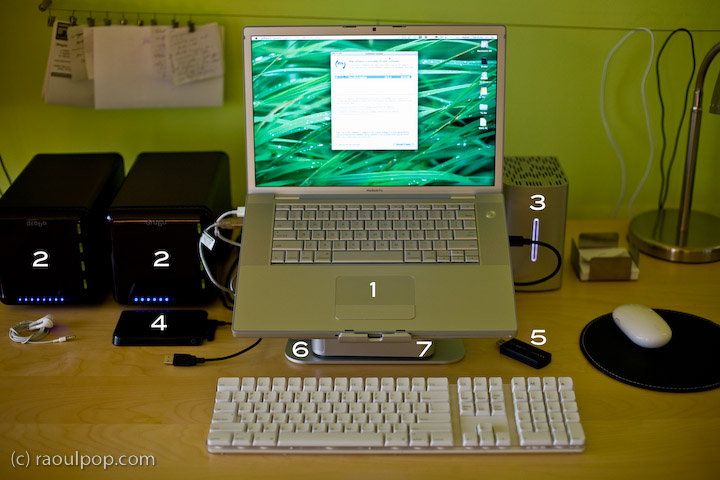
Here’s what you see above:

  1. 15″ Apple MacBook Pro: I love its dedicated 512 MB video card, and its design and speed. It allows me to focus on my work, not twiddle my thumbs while the computer plays catchup to my commands.
  2. Drobo: I have two of them. I store backups of my photos on one, and my videos on the other. Both of them are shared over my home network, so that my other Mac, a 20″ iMac G5, can access the videos and play them in Front Row.
  3. 2TB WD My Book Studio Edition II drive, running in RAID 0 (striped) mode: WD was kind enough to give me this drive as a gift of sorts, considering the significant problems I had with my 1TB WD MyBook Pro Edition II drive. I think they got tired of my complaining, and sent it to me to shut me up. Well, it worked. This drive has done great so far, and I have no complaints. I plan to write a review for it soon. I’ve been putting it through its paces so far, and it’s held up nicely. I connect it to my MBP through the Firewire 800 port, and I love the transfer speeds.
  4. 250GB WD Passport drive: I bought this last year, and it has been very useful. It’s small, stylish, and it’s powered solely by the USB port. I use it a LOT to transfer big files between computers.
  5. Turbo.264: a nifty little gadget built by the folks at Elgato, it speeds up H.264 conversions significantly. I’ve been putting this through its paces as well, and plan to write a review soon.
  6. mStand laptop stand: I love this stand, and reviewed it recently. It’s the best-designed stand for the MBP.
  7. newerTech miniStack v1: This is the first version of the popular miniStack drive enclosure. It uses PATA drives, and it has built-in FireWire and USB hubs (3 ports each). I use it as a USB hub, and it sits underneath my laptop stand — that’s why it’s not clearly visible in the photo. Both my Drobos are connected into it, and I have a spare USB port that I can use for my CF card reader, etc. If you want to have a better look at this enclosure, you can see it better in my Drobo review, where it appears in both the photos and the video.

As you can see, I aimed for simplicity in my setup. I wanted the most amount of processing power and hard disk space, in the smallest amount of physical space. You’re looking at about 5TB of storage in the photo.

Most of the heavy lifting (in terms of data crunching) happens on the WD Studio drive. I use it as a staging area for video processing, and transfer the finished, edited ones to one of the Drobos. I also use it to store and work with my Lightroom photo libraries. Working with photos in Lightroom from a Drobo is too slow for me, and the WD Studio Drive offers a visible advantage as I process each photo. I then back up my laptop and the WD Studio Drive to the Drobo through Time Machine.

You may recall I initially moved my photo libraries to one of the Drobos because I kept experiencing Lightroom library corruption and thought the WD Studio drive was at fault. As it turns out, Lightroom itself is to blame. Once your photo library reaches tens of thousands of photos (I have over 40,000 photos in one of my libraries), Lightroom will experience library corruption on a fairly regular basis. It’s just an unstable piece of software, and I hope that the next version will be better.

Just a quick note for those of you that noticed it. There’s a wire that runs behind the laptop, along the wall. The photo isn’t crooked, the wire is. I use it to hang small wires or notes to myself on it, and being loaded down with a few toward the center (which is only partially shown in the photo), it appears slanted. Sorry about that. It bothered me, but I wasn’t going to spend an hour or so in Photoshop cloning it out.

Hope this helped give you some ideas! If you have any questions, let me know.

Standard
Thoughts

Migratory state of being

Every single day, I go around with a little pain in my heart. It’s the sort of pain that only certain people can understand. These people are called immigrants.

Sometime this month, a familiar date will pass, and I’ll know that I’ve been in the States for 17 years. I’ve been a naturalized citizen for a number of those years. Born and raised in Romania, I came here when I was almost 15. I’ve lived the better part of my life in this country, and yet I still do not feel entirely at home. The States feels familiar, but not familial; it feels like I belong, but I don’t entirely fit in; it feels like home, but I don’t feel at home.

I envy Americans born here, I really do. In some ways, they’re better off than me. They feel something, every day, which I cannot feel; they may not realize it, and they may not even appreciate it, but they feel at home. It’s a priceless sort of feeling, and you don’t understand its true value unless you’re away from home.

It’s a painful way to live. I look around me, at those fortunate enough to have been born here, and they haven’t got my problem. They are at home no matter what part of this great big country they happen to live in — especially those that have been born, raised, and now work in the same cities or regions. They benefit from familiarity with customs, habits, lifestyles, places, people, language, traditions — all those things that make home feel like home. If they’ve moved to another part of the country, no matter how different they think it is, it’s still the USA, and it’s still the same country. Some things still apply, and the overall feeling of home is there.

Although I live in the DC area now, and have done so for the last 4 years, I spent most of my years here in the States in Florida. Still, it doesn’t feel like home. Sure, I know the streets and the neighborhoods. I know the cities and the beaches. When I walk or drive down a certain street, memories from my life there evoke certain emotions that make it familiar. The best word to describe that kind of a feeling is comfortable. When I step into my parents’ home down there, I get the closest feeling of home I can get here in the States. It’s relaxing and peaceful, that’s true. But it’s still not home. And I think my parents understand what I mean, since all three of us came to the States as a family back in 1991.

It would be logical to assume that Romania would feel more like home, since it’s where I was born and raised. You’d only be partly correct. Yes, when I go back there, I feel more at home than here. The strings of my heart vibrate at the same frequency as my birthplace. When I’m there, the air is sweeter, the food tastes better, interactions with people are more meaningful, every sensation is accentuated by the vibrancy of my home land. Sleep is more restful, and life takes on a new, familial rhythm. I feel a peace that I cannot feel here. Yet I do not feel at peace.

There’s the awful rub. In the words of Charles Laughton from the movie “It Started With Eve” (1941), “I’ve been tampered with!” I’ve spent so much time in the States that I’ve grown accustomed to the way of living over here. Not the comfort and abundance of products, though that’s part of it, but the way of life, of doing business, of approaching situations. I no longer fit in, in Romania, and I still do not completely fit in over here, after 17 whole years.

I can function just about anywhere, but am at home nowhere. I’ve got a mongrel heart, a split state of being, and it’s a sad, painful way to go through life, at least for me. A piece of me exists in each country, and I’m forever torn between the two.

It must be even worse for Ligia. She’s only been here for 4 years. She spent her entire life in the same region of the country, in a very close-knit family, among friends and relatives, and the only reason she left all of that was to be with me. It’s probably safe to describe the way she feels every day as home sick. At least she’s lived enough in one country to know which one feels more like home. Although the more time she spends here, the more she’ll bond with this country, till she’ll be just like me, a mongrel spirit.

I think of the pilgrims that came to the new continent from Europe, hundreds of years ago. I wonder how they must have felt, knowing that the likelihood of ever going back to their home lands was next to nothing, and having to face the rough conditions that awaited them in untamed territories. Perhaps the tough lives they led, and the blood, sweat and tears they put into eking out an existence bonded them more to their new homes. Or maybe they sat down on quiet evenings and silently bore pangs of sorrow over the distance that separated them from their birthplaces and ancestral homes.

Then I envy their children, who didn’t (and don’t) have to worry about any of those things. And I yearn for the normalcy and peace which I don’t think I’ll ever reach.

Standard
Events

Merry Christmas!

I know Christmas isn’t celebrated by everyone, but if you’re one of those who does celebrate it, Merry Christmas! Even though the origins of the date are pagan, the meaning we have chosen to ascribe to it over time is certainly worth celebrating. For those among us who are Christians, it means our Savior’s birth. For others, it means that time of year when we think of others, and give them presents. For others still, it’s a joyous holiday time spent with family, winding down the year and looking forward to the next. However you choose to celebrate it, I hope you’ll enjoy these next several photos I’ve prepared.

As Christmas nears, I love the change that comes over the home. The decorations make it a special time of the year.

Christmas time

Keep the light burning brightly

Let’s not forget to pick out just the right Christmas tree.

Got that tree?

And fill it full of wonderful ornaments.

Play that golden harp

A wreath of holly

How about the last minute gifts that we forgot to get? What to pick, I wonder?

The last minute gift

As Christmas Eve draws near, some of us like to sing Christmas carols.

Let’s sing in the town square

On Christmas Eve itself, we have a wonderful Christmas meal. In my family, the food we make this time of year is always special and plentiful.

Seeker of light

By the way, this is how the sunset looked on Christmas Eve this year.

Christmas sunset

Those of us who choose to ascribe a religious meaning to Christmas remember the story of the star in the East, and of the angels’ appearing.

Visitation

A star in the East

That ocean of angels that filled the sky on our Savior’s birth night must have been a glorious sight. This is a poor approximation, but it will have to do.

Apparition

According to popular legend, the little town up North where toys get made is pretty quiet on Christmas morning. Perhaps it looks something like this?

The little town where toys get made

Merry Christmas!

Standard
Reviews

How houses get built in the DC area

I thought that when I lived in Florida, the construction there was shoddy. I was wrong. At least there they used concrete pillars and floors for the houses, and the building code was so strict everything was anchored properly, especially after Hurricane Andrew. When I moved to the DC area, I thought construction would be better here, since it’s a temperate climate and the houses should be built to last and hold up to the weather. I was wrong. Construction here is horribly shoddy.

I have never been so shocked at the cheap and flimsy “workmanship” I see every time I pass some house or building under construction. It never ceases to amaze me what passes code in these parts, and I’ve lived here since 2003. It’s downright thievery, I tell you. I’ll show you some photos below to help you see what I mean. I call it thievery because you’d think housing would be dirt cheap given the materials and level of effort that goes into the construction, but it isn’t. It’s terribly expensive, to the point that people making below what would be called upper middle class in other parts of the country can’t afford to live inside the Beltway, much less outside it. They have to go find housing either in bad neighborhoods, or way out in the boonies, in order to get anything affordable.

It’s not right. It makes my blood boil. Honestly, I can’t believe what goes on. It’s the same construction everywhere, from the (relatively) cheaper townhomes and single family homes right up to the McMansions that have sprung up on River Rd, Georgetown Pike and other richer places. The only thing that changes is the size and price of each monstrosity, but they’re all just as flimsy.

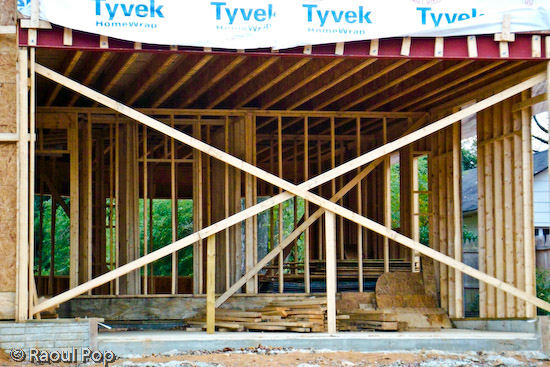
Do you want to see what I mean? Take a look at these photos. They’re from a house currently under construction in my area.

House under construction

Some unwitting soul is going to pay several hundred thousands of dollars for this piece of crap, and he won’t know what a lemon he’s getting. It’s all 2×4 construction. There’s nothing solid and concrete there except the foundation, and I’m not sure how thick that is, either. It’s all either cheap, soft wood or plywood, including the upper floor. Not only that, but the beams aren’t straight, and the joints aren’t secured properly.

House under construction

It’s basically a big plywood box. I’m not sure what its projected lifetime is, but I can’t imagine it’ll last more than 30 years. It’ll start needing serious repairs even before the mortgage is paid off. Isn’t that terrible?

Do you see that cheap, flimsy Tyvek plastic? That’s the weatherproofing. No, I’m not kidding. That’s it. That’s also the insulation. I doubt they’ll put glass fiber or any other kind of insulation between the drywall and the beams. They might, but I seriously doubt it. I’ve seen the inside of many walls, and they’re usually empty.

House under construction

Can you say cheap? I can. It’s cheap construction! It’s a travesty. Look at that horrible plywood shell. That’s going to be a tower. It’s going to look so nice, clad in fake brick or plastic siding only 1-2 inches thick… It’s also going to be horribly inefficient when it comes to temperature preservation. And if water should happen to leak in through that cheap brick cladding and through that flimsy Tyvek sheet, the plywood will rot away quietly and the owner won’t even know it… Wonderful, isn’t it? Isn’t this piece of crap worth mortgaging your life away?

Should we be ill-fortunate enough to get a hurricane or some tornado in our area, the roof on this thing will probably get torn off, and the entire house might or might not be standing when nature’s done with it.

Look, don’t get me wrong. I understand that America has a long history of 2×4 construction. It’s how the West was won. It’s cheap, affordable, goes up quickly, etc. But this isn’t the West, and it’s not the 1800s. This is the supposedly refined East. We should know better by now. It’s our nation’s capital. And the prices of these plywood boxes aren’t cheap. No, they’re so high most people can’t afford them.

I also understand the builders have to make a profit and the cost of land in this area is expensive. But this is ridiculous! If you’re going to build something that someone will want to call their home, and will pay dearly for it, sinking most of their productive, working years into paying it off, then God help you if you don’t build something worthwhile, something that’ll last. You’ll get what’s coming to you, don’t you worry about that…

What I wonder about is how the people and companies that put up these things can live with themselves. That’s what I want to know. How can they sleep at night knowing someone’s going to pay a fortune for something that’ll start falling apart after the first several years, for something that’s so horribly inefficient when it comes to energy use that they’ll be paying through the nose to cool it in the summer and to heat it in the winter? Don’t tell me about efficient windows! You can get the most expensive windows out there — if the walls themselves can’t conserve the inside temperature, you’ll still be nowhere. There’s such a thing as global warming to worry about. Have you heard of it? Everyone needs to reduce their carbon footprint, and it starts in the home.

Whatever happened to the good, old masonry work? What happened to quality stone construction? Yes, it’s more expensive, but isn’t it worth it? Why can’t you builders put a little more pride in your work? Why can’t you make a concrete skeleton, and use thicker insulation and better materials for the cladding? Is it so hard to do? So you’ll make a little less money. You might have to mark up the price a little. You might have to educate the consumers that know nothing about quality construction. But isn’t it all worth it in the end? Won’t you feel better knowing the house you built will last a long time? Won’t you feel better knowing the people that will buy your house will thank you for your solid construction later? Isn’t it it worth it to build good will instead of ill will?

Standard
Reviews

Windows Family Safety

Windows Family SafetyWindows Family Safety (WFS) is a new offering from Microsoft that aims to offer protection from questionable or indecent websites to families or individuals. I tried it out for a couple of weeks, and found it to work fairly well, except for a few hiccups here and there.

It is a software-based internet filtering mechanism. The difference between a software-based internet filter and a hardware-based one is that the software needs to be installed on every computer where filtering is desired. A hardware-based internet filter is usually self-contained in a box or appliance that gets placed between the user’s internet connection and the internet. The benefit of such an appliance is readily seen. There’s nothing to install on client computers. Unfortunately, hardware-based solutions have been fairly expensive, historically speaking.

Software-based internet filtering has also cost money, until now. As a matter of fact, Microsoft used to offer one such software-based solution with its premium MSN service. Windows Family Safety may be that same offering, repackaged as a free service.

Having used other software-based internet filters, I can tell you Windows Family Safety is a lot easier to use, and much less annoying than paid products. Those other services, who don’t even deserve to be called by their names, were just plain awful. I had to authenticate every time I tried to access a website, and logins didn’t even take at times. What’s worse, if a single website called out to other websites to display information, as is so common these days, I had to authenticate for every single request. They were a nightmare, and I quickly uninstalled them.

Windows Family Safety requires a simple install, and the selection of a master account which can set the level of access for that computer. It uses Microsoft Passport sign-ons, which means I was able to use my Hotmail account to log in. After that, it was a matter of logging in every time I turned on my computer or came back from standby. This was one area where I encountered a hiccup though. The software had an option to allow me to save my username and password, so I wouldn’t have to enter them so often, but that option didn’t seem to work. I was stuck logging in much more than I cared to do, but still, this was nothing compared to the torture I went through with other software-based filters — as already mentioned in the paragraph above.

Just how does WFS work? It turns out that it uses a proxy to filter the traffic. It means that every time you make a call to a website, that call first goes through the WFS servers, where it gets matched to their content database and the website deemed to be appropriate for the level of safety that you’ve chosen. Here’s where I encountered two hiccups.

The first was that at peak times, the speed of my internet connection was slowed down to a crawl until it could pass through the fairly busy proxy servers and be filtered. That was really annoying, but I assume that’s going to get better as MS dedicates more proxy servers to the service. Perhaps it might be better to download content filters directly to each computer and filter the traffic locally, so the chance of a bottleneck is reduced or eliminated.

The second was the seemingly arbitrary designation of some sites as inappropriate. I chose to filter out adult, gambling and violent websites. Somehow, both of my blogs (ComeAcross and Dignoscentia) didn’t meet that standard, which was very surprising to me. Neither of those sites can even remotely be classified under those questionable categories. Fortunately, there’s a fairly simple process for requesting that a site be reconsidered for proper classification, and it’s built into the Windows Family Safety website. I followed the procedure, and within days, my sites were properly classified. But the fact that I had to go through all of that makes me wonder how they’re classified in the first place.

Overall, I found that WFS still hasn’t gotten proper branding. What I mean by that is that it’s not clearly identified as a product by Microsoft. The Windows Live OneCare Family Safety website is part of the Live Family of sites, true, but it’s not even identified on most of the other sites in that family (Hotmail, SkyDrive, etc.) I also found that configuring one’s WFS account can be pretty unintuitive, as the navigation on the WFS site is cumbersome and lacking focus (much like the Windows Live OneCare site, come to think of it.) I even got code errors when I tried to surf through it recently, which is not what I expected from a public MS site.

On a general note, Microsoft really needs to do some work in associating each MS product with the Windows Live account that uses it, and making it easy for each user to access the online/offline settings for each product. Google does a great job with this, and MS could stand to learn from them here.

Windows Family Safety is a good solution, and it works well considering that it’s free. If you’re looking to set up some easy internet filtering at your home, it could turn out to work great for you. Give it a try and see!

Standard