Thoughts

Photography, take two, part three

This is Part 3 of an ongoing series of posts that outlines the work I do behind the scenes to improve my blog’s content. You can read Parts 1 and 2 as well.

I continued my work of replacing photos hosting with third party services with self-hosted ones. Here are the posts I modified:

This last post doesn’t use any photos, but I did re-edit it to make it easier to read:

As a matter of fact, all of the posts included here were either re-edited or re-written. I said it plenty of times in the past, and I’ll say it again: I want to have top notch content on my blog. I only wish I had more time to go through all of my older posts and delete, combine or re-write as needed. When I look back at some of my earlier posts (from early 2006), I cringe. They’re very short, mostly linking to other things or quoting extensively. That’s not the kind of writing that represents me. I’ll do my best to edit them as time goes on.

Standard
Thoughts

A look at culture and technology through sound effects

I was listening to the radio one morning, and realized the sound effects they were using to advertise a website were the clicks of a keyboard likely made in the 80’s — you know, long key travel, spring-loaded action, hard clicks. But it worked.

More importantly, it is the only sound that can approximate a keyboard well, and transmit that action to an audience. Think about where keyboards are going today though. Apple is putting out keyboards that barely make any sounds — for example, see the new slim iMac keyboard, or the MacBook or MacBook Pro keyboards. Other hardware manufacturers are following suit, each advertising softer keys, more muffled sounds, etc. How do you record that? It can’t translate well over radio as a sound effect.

Remember how they used to advertise accessing the internet just a few short years ago? Through the sounds of modems. Tell me, could anyone afford to advertise internet access like that any more? No, they’d get laughed out of business, because most everyone is using high-speed access now. But is there a sound that can represent an Internet connection now? How do you represent it or record it?

What about the sound effects for phone calls? They were the simple, old-fashioned ring, right? Everyone knew what it was, and there was no confusion. Not any more. Although people still recognize the old phone ring, children growing up nowadays have so many choices when it comes to ringtones, that soon enough, the old phone ring will no longer be a recognizable sound effect for phone calls.

In some of the older movies or radio commercials, beeps, flashing lights and loud sounds were used as sound effects for computers. The starts and stops of tape reels were well known as well. What about the sounds of the punch cards, rolling through the machines and getting processed? Those are all things of the past. The only sounds computer hardware makes nowadays is the drone-like noise of the hard drives and cooling fans. It may be the representation of an efficient computing machine, but it’s pretty boring as a sound effect. Desktops or laptops (the newer ones anyway) make no sounds at all. We prize them based on how little sound they make, and rightly so, but we’ve lost the sound effects.

Remember the sound of switching TV channels? There was the manual, hard click of the round knob on the TV set (not many of you know about those anymore). If you were using a remote on older televisions, there was a sound pop, followed by a short period of static and the sound of the new channel that accompanied each channel switch. On newer televisions, that’s no longer the case. There’s no pop, click or jarring sound transition during channel switches. It’s all handled smoothly, and on some, the sound is gradually brought up to listening volume so as not to disturb you. But how do you represent a channel switch in a radio ad? You can’t, not anymore, not unless you use a decades-old sound effect.

The point of all these examples is to illustrate how technology is outpacing culture. I wanted to look at this through sound effects, but there are many ways in which it can be done. Just think of social networking sites, their invasion of privacy, and the new expectations of online behavior if you want to look at another aspect of this same issue.

One thing’s for sure — our culture has some catching up to do. While I love technology and embrace it (for the most part), we have to recognize that we’re in uncharted territory nowadays, in many, many areas of technology, particularly at its intersection with people and general culture. The rules aren’t even getting written, because no one is sure just how to grasp the situation. We each understand but a little portion of what’s going on — and that’s both scary and exciting, depending on your point of view.

Standard
Thoughts

A rule of thumb to help you avoid accidents

So many traffic accidents happen when we don’t keep our proper distance from the cars in front of us. Here’s a simple equation to help you do just that:

Distance (in car lengths) = (Speed/10) – 1

Let me explain it. Say you’re going along at 20 mph — the distance between your car and that in front of you should be 1 car length. If you’re going along at 40 mph — the distance between your car and that in front of you should be 3 car lengths. Obviously, the formula given above is no good at speeds below 10 mph, so use your judgment there. I try to leave half a car-length to 1 car length between my car and someone in front of me, even if my speed is fairly low. I never know when they could brake suddenly. People’s actions can’t be predicted, and it’s best to have a little room for error in our calculations and reflexes.

I would go further and add an additional car length to that distance — in other words, modify the equation as follows, if you’re older and have problems seeing, if it’s dark, or if it’s rainy or foggy.

Distance (in car lengths) = (Speed/10)

If it’s snowing or it’s icy on the roads, by all means, drive slower and keep as far away from the car in front of you as you can. There’s no way to approximate distances in those situations. You never know just how your car will behave when you brake. Just hope you don’t have to brake on a particularly icy portion of the road, because you’ll skid all over the place, and chances are you’ll hit something.

MINI Cooper S on snowy country road

One additional word of advice. If you’re going to drive through snow, sleet or ice, make sure you’ve either got winter tires on your car, or you’ve got good all-season tires that aren’t worn out. And be sure that your brakes are in good working condition.

I don’t claim to be a traffic safety expert, so don’t think this rule of thumb is written in stone. See how my advice will work for you, and let me know if you think my equations need some adjustments. The idea is to keep the math simple so that everyone can understand and benefit from this.

Standard
Thoughts

Better video

I’ve wanted to be able to post the videos I upload to Vimeo on my blog for some time, but the WP video plugins just hadn’t caught up. I’m glad to say that I found one tonight. It’s called, appropriately enough, WordPress Video Plugin. It’ll work just great for most people, so I encourage you to try it out.

I wanted to take advantage of the full width of my blog’s content column, so I modified the Vimeo code to make sure that my videos get sized to a width of 550 pixels and also stay centered.

I’m happy to say that I really like the results. You can see the modified plugin in action on these three posts:

Since I record my videos at a resolution of 640×480 pixels, it’s only natural that I display them at the maximum width possible on my site, right?

Standard
Places

A place out of the ordinary

Ligia and I made a trip to a place out of the ordinary this past Saturday. Not many people have been there, that I can guarantee you. It’s pretty close to civilization, and you can get there by foot. What was it? The middle of the Potomac River, near Glen Echo, MD.
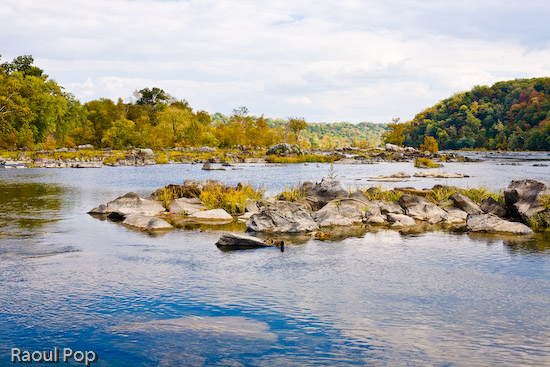
In the midst of it

Our area’s experiencing a drought. It’s not very bad (yet). One side effect of this is that the Potomac River runs fairly low to the ground, and that means one can hop and skip from stone to stone all the way to the middle of the river — if he or she can keep their balance and find their way around.

We found a path that led from the C&O Canal to the Potomac River, and followed it. A multi-hued cover of fallen leaves lined it nicely.

The way

A side branch of the river divided the mainland from a small island. The river bed here was mostly dry, so we made our way over the stones to that island. I spotted the beautiful reflection of trees in the water, and stopped to take this photo.

Fall reflections

We trekked carefully over the island. There are snakes in that area, and they usually lie in the shade among the rocks. We didn’t want to give any of them a rude awakening and risk a bite.

Ligia stopped on a big boulder at the edge of the island to rest and take some photos, while I ventured out over rocks covered with dry mud and algae. Shrubs grew among the rocks, taking advantage of the moisture still present in the mud underneath.
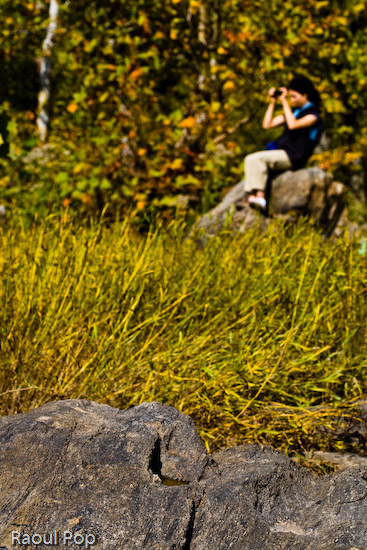
Perched and ready

As I got farther and farther out into the river, there were less and less plants, and mostly bare rocks. One stray acorn made the unfortunate decision to sprout a little tree on a patch of mud. I wondered what would happen to it when the water level would grow once more.

Contemplating the future

When I reached the approximate middle of the river, there was no more sure footing, and I didn’t want to risk acting like a mountain goat. That would have been a sure-fire way to get wet really fast and/or break a limb. Besides, I had a great vantage point.

Far from the shore

One thing that always attracted me to the Potomac River was the exact same reason that it’s not navigable by boat: the many rocks and boulders that can be found everywhere. That’s something you don’t see in many other places. It’s this sort of raw, untamed natural beauty that makes me think of James Fenimore Cooper novels, and to imagine Indians still roaming the shores. If you look at the photo above, you’ll see this gigantic boulder looming just a foot or so under the water level. That’s really impressive to me. Its sheer mass would crush a boat’s bow to pieces without flinching.

Meanwhile, I was standing on another solid rock. You know how they say 90% of an iceberg is under the water’s surface? Well, this is a good way to illustrate that concept.

Solid rock

I must have stayed there in the middle of the Potomac for at least half an hour, gazing at the nature that surrounded me. The brisk river breeze carried the unmistakable scents of autumn down the river. Ligia came to join me and we sat there together, looking at what you see below.

There’s a peace and a thrill that takes hold of you when you visit a place like this. It’s peaceful because there’s no one around. And it’s thrilling for the very same reason, and for the knowledge that others probably haven’t been nor will be there any time soon.

The golden afternoon sun streamed through the autumn leaves, untamed by the clouds that raced along the sky. This is one of those photos where everything seems to come together to create the perfect capture of a fleeting moment.
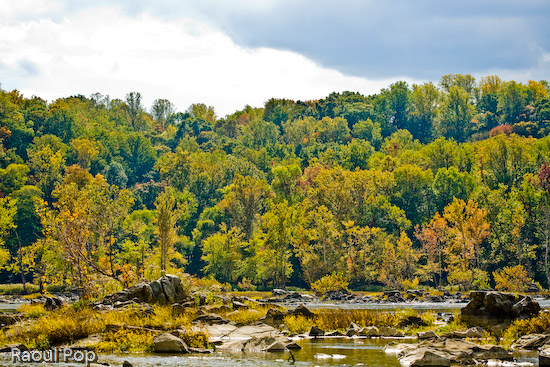
The colors of fall

The Potomac moved by at a slow, untroubled pace, the water reflecting the sun in a sort of knowing, passive resistance to its power. It knew that power would soon fade as winter moved in.
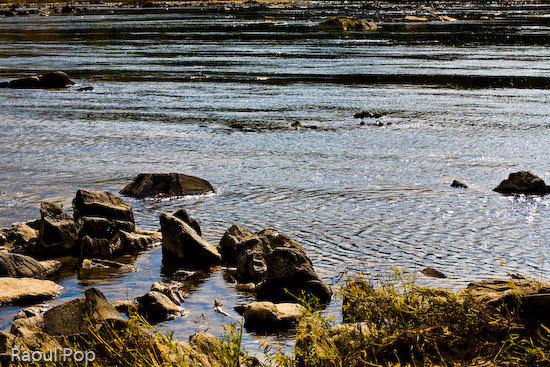
Little islands

Just up the river, about a mile or two, I could see the American Legion bridge. I-495 crosses over the Potomac there, and I drive on it every day on my way to and from work. That same bridge has been under repairs for most of this year, and I blogged about the traffic problems that the construction caused. Thankfully, that’s over now. You can see the bridge in the photo if you look carefully. It’s in the top left portion.

In the midst of it

As I drove over it each day, I used to look over the side wistfully and imagine myself somewhere in the forest, photographing the river and the morning fog. I can’t imagine how many people pass over that bridge every day and care nothing for the view. I must remember to come back some early morning to catch the fog. It’s a real pity that there isn’t some sort of overlook built onto the bridge itself, to allow people to look down the river. It would be a magnificent sight.

As Ligia and I started to head back, we counted our blessings. We’d just visited an amazingly beautiful place, one mostly untouched by human feet, and we managed to get photographs that would preserve that memory for us for a long time to come.

Standard