How To

Making the custom bed frame

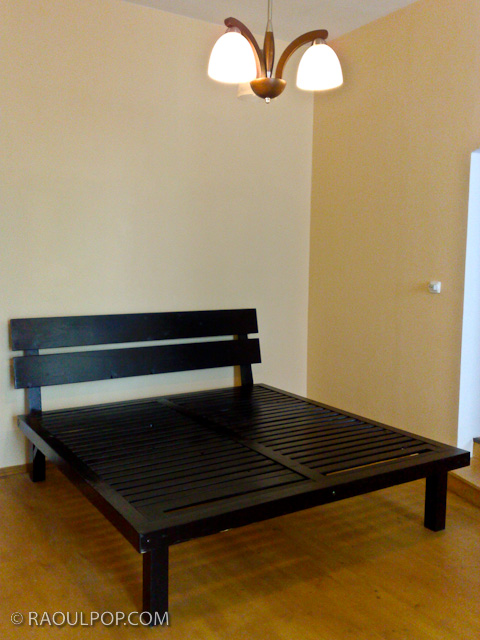
Last summer, I made a custom king size bed frame for our bedroom, out of solid wood. I held off on writing about it until now, nine months later, because I wanted to make sure the end result was solid and worth writing about. We’ve been sleeping on it ever since, and there’s nothing wrong with it, so yes, I can heartily recommend it.

I was fed up with the laminates and particle board garbage they call furniture these days, and I wanted to build something that would last, out of a quality, sustainable material like wood. I chose pine, because it was softer and easier for me to work with. Although I’ve also built a custom cat house for our three cats, I’m no expert carpenter. I just like to work with wood. It’s a wonderful material.

Continue reading

Standard
Thoughts

Metadata: DNG vs RAW

Generally speaking, I prefer the Adobe DNG format over the proprietary RAW format given to me by a camera, because I like the fact that it’s more or less future-proof. With a DNG file, the meta-data resides inside the file — like with a JPG — but the format is lossless, same as a RAW file — and unlike a JPG.

In spite of the fact that it’s a “publicly available archive format”, I would like to see more camera manufacturers adopt it, so I can feel more comfortable using it. I realize companies like Hasselblad and Leica have already adopted it, and you can take photos directly in DNG format on some of their cameras, but until the big camera manufacturers like Canon and Nikon adopt it, it won’t have the mass acceptance it needs to ensure its long-term survivability.

Still, I have begun to convert the RAW files in my photo library to DNG. By my count, I have converted about 30% of my 77,000 photographs to DNG format, and I am converting more of them every day. Let’s hope Adobe sticks to its word in the future and I’m not left holding the bag, having locked my photos into a format that might become obsolete.

Long-term benefits and potential caveats aside, I should point out a more current disadvantage between DNG and RAW. It has to do with metadata.

Yes, it’s true that with a RAW file, you’re stuck working with your metadata in sidecar XMP file, and that file may get corrupted, or you may lose it, thus losing your metadata and the processing directives for Camera Raw or Lightroom or whatever you’re using to process your photos. With a DNG, everything resides inside the file. There’s no XMP file, which is a good thing, most of the time.

But when you’re backing up your library, and let’s say for the sake of the argument that you’ve got to back up 20,000 photos, which is what I’m doing right now, and you’ve made minute changes to the metadata of all those files — only changed one EXIF or IPTC field — the backup software won’t care. You’ll have to back up 20,000 DNG files, each (in my case) between 12-24 MB. That’s going to take a LOT longer than backing up 20,000 XMP sidecar files, each of which is only 15-25 KB, because those are the only files that will have been changed if I update the EXIF or IPTC data for a whole bunch of RAW files.

That’s one area where RAW trumps DNG. I’m willing to overlook it if DNG will indeed prove to be a future-proof format, but that remains to be seen.

Standard
Places

Italian road trip – Day 3 – Venice – Part 2

Part 1 of the Venice leg of our Italian road trip ended with our entrance into the Piazza di San Marco. That’s where this story begins.

As you can see on the map, the city of Venice isn’t made up of a single island, but multiple ones. This will prove interesting later on in the post, when you’ll see photos from the Campanile of the Piazza di San Marco (the Bell Tower). For now, let’s see what there is to see in the Piazza. As with the previous post, you can see the photos in the slideshow embedded below, or you can scroll down to see each photo and read my accompanying thoughts.

Continue reading

Standard
Places

Italian road trip – Day 3 – Venice – Part 1

On the third day of our Italian road trip, we left Florence and started on our way to Venice.

This post contains 50 photos, so get ready to spend about 15-20 minutes here. You can see a slideshow below, or you can scroll down to see each photo alongside my thoughts.

First, we needed to find a place to stay for the night. We kept driving and driving, through Modena and on to Ferrara, but no decent hotel or pension presented itself to us. We veered off the highway, hoping to find a nice, quiet pension in the countryside, but we couldn’t see anything. It was getting darker, and we were getting desperate. We were tired after a long day of walking and driving, and we wanted to rest.

Continue reading

Standard
Thoughts

Changes in TV viewing habits

The BBC reported recently on how TV viewing is becoming a more social experience. When I read through that article, I said, hang on a minute, I had an idea back in October of 2005 along the same lines… I called it audience-inclusive advertising, but the thoughts I wrote in there can be applied to other content on TV, like shows, which is what’s currently happening.

It’s fun to read through my original article and see how much of the stuff has already come to fruition. Here’s one:

A site can be set up and maintained by a consortium of advertising agencies and brand owners or a neutral body, that would either track viewer product preferences through data mining and random surveys, or would actively encourage users to register and provide product preferences. Alternately, existing user data could be compiled from various databases.

Now we have Facebook and Twitter, and advertisers love to mine their data sets for user product preferences, to give them surveys (think of all the annoying quizzes on Facebook), and collect data on them every time an app is authorized. So this has already happened.

Through the medium of the website, brand owners can also take a cue from the users about the kind of products they need to advertise, this time in a more direct way, through hard data. Even more, they can more easily survey the users about the kind of new products they want to see.

Think of all the fan pages set up on Facebook by companies and brands. You can become a fan, learn more about the company, and be surveyed, live, about your preferences. Beautiful.

Another way to keep the audience is to offer prizes for watching the ads and picking through clues that are weaved through both the ads and the shows. Entries can then be registered on the show’s site or at this main site for a chance to win something, perhaps even products featured on the show, or something as banal as an actor’s coat, or the actual bottle of perfume used by an actress on the show. These aren’t things that cost much but mean a lot to the audience.

Do you notice how many product giveaways there are on Facebook and Twitter? Companies are giving away not just stuff that doesn’t cost a lot, like an actor’s wardrobe, but they’re giving fans cars, computers, cameras, TVs and other things that cost a fair bit of money. And it’s all done for the purpose of keeping users (fans, if you will) tuned into the company’s platform and brand.

It’s also fun to see what stuff didn’t get implemented (yet?), but I’ll let you do that by reading through my original article.

Standard