Thoughts

Using the economy as an excuse to shortchange employees

I’ve seen companies do some pretty disgusting things in my time, and the move some of them are pulling lately definitely ranks right up there with some of the biggest stinkers.

In effect, they’re using the current weak economy/recession as an excuse to lay off employees and burden the existing ones with the extra work, while keeping them mum under the fear of losing their jobs. If this isn’t corporate exploitation of its workforce, I don’t know what is.

I’m going to give you three examples, each juicier than the other, but I’m sure you can come up with more if you’re in the US and you’re employed in a full time job.

The niche business with an owner

I talked with an employee from a certain company lately, one which specializes in a niche market that has not been affected by the economic slowdown, nor does it look like it will be affected any time soon. I can’t disclose any identifying details, because the employee confided in me. What he told me was this: the president (and owner) of the company fired some employees while cutting year-end bonuses for the rest of the employees, using the recession as an excuse. The employees, the ones doing the hard work, have been handling a record amount of business for the past year, but the president cited a slump in incoming business. I was told the same president has been spending lavishly to expand his own mansion and buy extra cars and toys, during the same year when the supposed slump in business took place.

Adobe’s record profits

This example is more concrete than the previous one. In December, Adobe reported record revenues for the 4th quarter of 2008, and the sixth consecutive year of double-digit growth, yet they still laid off employees in November just the same. I’m not surprised though. I talked with a friend who is a long-time software developer, and he told me Adobe has another ugly habit: historically speaking, they have relied mostly on contractors, because it’s cheaper, and they’re easier to shed without bad press.

JPG Mag starts a bidding frenzy

Let’s look at JPG Mag. It’s the darling of many amateur photographers, because it gave them the chance to publish their work when other magazines might turn them down. I never really liked it, and I’ll tell you why: I thought they were cheap.

Here was an easy way to get print-worthy photographs without paying a dime. Turns out you could get amateur shutterbugs happy and willing to give away their work simply by dangling the illusory promise of publishing their pics in your magazine. The incentive was fame, which is as fleeting as a fart and just as troublesome, if you’ll excuse my expression. Where’s the moolah? Last I checked, bills were still payable in money, not fame.

When they announced they were going under, I thought it fitting. Good riddance to bad rubbish. First they don’t pay the photographers, then they fire the founders, now they’re going under — okay by me. Unfortunately, the buzz generated by their announcement stirred the vanities of those with bigger wallets, and a bidding war began.

But wait, there’s a nugget of bitter truth to be found among all this fake glimmer and shine. Turns out they fired all their employees, and now the CEO trumpets the company’s earning potential in messages to the bidders. PDN Pulse called them out on this, and rightfully so. Sure, now the company has earning potential since everyone’s gone. Hire a skeleton staff, make them do double or triple the work, pay no money to the photographers, and you’ve got a hand-dandy business model fit for the 21st century.

To sum things up

So you see, it’s okay to use the economy as an excuse when it befits your bottom line. Apparently, it’s okay to lay off people, it doesn’t matter that they’ve got bills to pay, that they’ve put a lot of hard work and time into your company. You shouldn’t do what you can to protect them in a weak economy when it’s harder to get jobs.

None of that matters, right? Ethics are so passé. You just use whatever excuse you can to make sure your precious bottom line gets bigger and bigger. It’s all about GREED. You can never have enough money, and people are only a means to it, right?

Well, I think that’s wrong. I don’t care if you’re afraid that the recession will affect your company. I don’t care if you really want that shiny new toy and a couple of employees and their mortgages stand in your way of getting it. I don’t care if your stockholders will bitch. If greed and money are your only motivators when you run a business, and you’d gladly step over people to balance the spreadsheets — don’t give me any of that I’m so sorry and I feel your pain crap — then you’re a spineless, slimy, pus-covered slug, and you deserve to be squashed under a steel-toe boot.

Standard
Thoughts

Premium gasoline dips below $3 per gallon

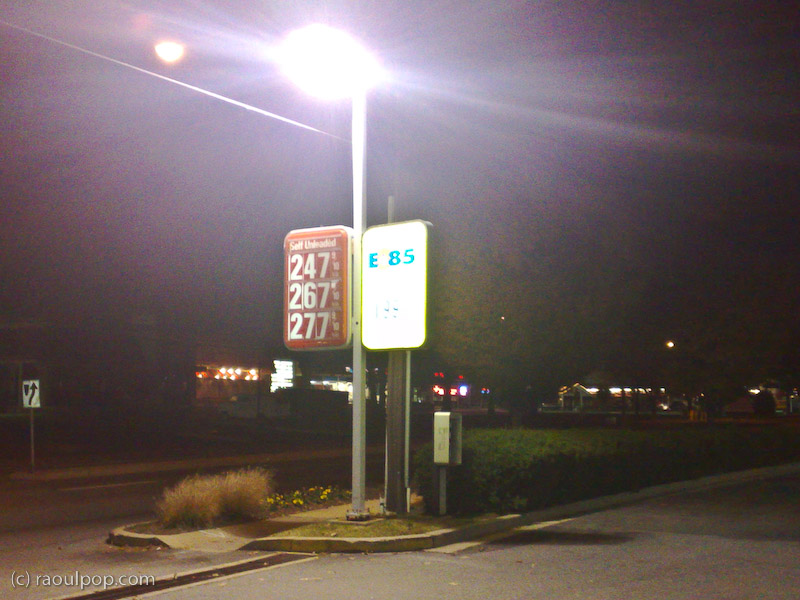
As I filled up my MINI a couple of days ago, I glanced at the pump and noticed the price of the premium gasoline: $2.77 per gallon. I couldn’t believe it. I left the pump running and ran toward the street sign to take a photo.

I just didn’t think I’d ever see premium gas dipping below $3 again. While I’m sure others welcome the change — and I can’t say I disagree when you consider the issue solely from the point of view of one’s bank account — I still say gasoline needs to stay above $3 at the pump, in order to encourage proper driving behavior and to make research into alternative fuels and technologies viable.

It wasn’t that long ago that I paid $4.45 at the pump to buy premium gasoline for my MINI. There’s a huge difference between $4.45 and $2.77, and I don’t like this sort of yo-yo behavior when it comes to gas prices. First it was too high, and now it’s too low. It’s not right. It needs to stabilize somewhere between $3-4 dollars per gallon, preferably somewhere between $3.00 and $3.50.

If you’d like to read more about my thoughts on a gasoline tax (which isn’t a new idea, but already in use in Europe), see this post from March of 2005.

I took the photo above with my Nokia N95.

Standard
Thoughts

A few words on the economic crisis at hand

I’ve just got to say what I’m about to say, because it’s gnawing at me from inside, and I need to have it out. I’m not going to pretend I’m some economic guru, and I’ll use plain words.

My thinking on economics is simple. I understand tangible products. If an economy makes stuff I can touch and see, if it manages to sell that stuff both inside and outside the country, and the unemployment rate is low, then things are well.

I think things started to go sour when our industries decided to shift manufacturing to third-world countries. The thinking was that cheaper labor would result in cheaper products and lower prices. The truth was that it took jobs away from our country and it really only resulted in higher profits for the investors, not lower prices for us. As more companies would announce they were moving factories abroad, I would wince, because I knew our economic power was decreasing with each and every move. When you’re making less stuff in your own country, it’s plain common sense to realize that your economy is weaker.

As our economy started to move away from manufacturing and toward the service sector, I winced again. If you’re not making tangible products, what are you really making? Services? Knowledge? That’s all nice and good, but you can’t base an economy on intangibles. You just can’t. You have to have a good, healthy mix. I suppose I shouldn’t complain about this so much, since I work in IT. Still, at least what I make is tangible. I make websites and web systems. You can see and touch those, or click on them anyway. But not everyone can be a knowledge worker. It takes a certain amount of dedication, interest, perseverance and education, and many people simply don’t have the inclination to do that, or to be knowledge workers. That’s where having a good mix of jobs to offer your people is important. The more manufacturing jobs you move away from the country, the less variety you can offer your people. Plus, what do you do with all the folks you’re laying off as you “restructure” your economy?

When real estate prices started going up like crazy, I knew they’d come down, hard. They were bound to do so. When a pathetic little townhouse with a few tiny rooms, made out of plywood and fake brick cladding, cost over $400,000, that couldn’t be good. As prices kept going up, and people bought up multiple properties using ARMs, banking on the hope that the values of these properties would continue to grow, but no regular person could afford to actually own one of them, that was just plain wrong. When the home prices in most neighborhoods are so high that they’re out of reach for most, that’s asking for trouble.

Then I heard about the gaming that went on behind the scenes, as loans were approved by mortgage companies which seemed to sprout out everywhere. We knew someone who worked at one of these companies, and that person was just shocked at what went on. Executives would push employees to approve more and more loans only so they could get fat bonuses and afford McMansions and Mercedes cars. Meanwhile, the employees got nothing but low pay and long hours.

What’s more, I also heard about investment firms buying up groups of mortgages left and right, and re-selling them, and creating ridiculous layers of investments and speculations on top of these (mostly) insecure loans, in order to squeeze as much profit from them as possible. I’m sure that if you go back and check most loans, you’ll find 5-6 layers of additional financial speculation on top of the original mortgage. That’s insane and it makes me sick when I think about it. Instead of letting someone borrow money and charging them the set interest fee for the life of the loan, banks were selling these loans left and right as soon as the papers were signed, not caring where they ended up, letting others take the fall when and if the loan defaulted, etc ad nauseam. I knew that wasn’t going to end well.

Fast forward a couple of years to where we are today, and is it really any surprise that we’re here? Is it? And what’s being done about it? The government wants to bail out the banks and give them insane sums of money. You can’t do that! If they’ve mismanaged their own money so badly over these past several years, while their executives got filthy rich, let those same “smart” executives figure out how to fix their own problems! But no, what we’ve got now are scare tactics employed across the main stream media, where politicians and bankers are trying to scare us into giving in and allowing the bailout plan to go through. We’ve got bankers lobbying politicians to get the plan passed, and we’ve got them salivating at the thought of getting a piece of the bailout pie. This is ridiculous and irresponsible!

I keep thinking about Bush’s televised speech when he wanted to go into Iraq. And then I think about his speech just a few days ago, where he used the exact same scare tactics and language to try and get us to agree to the bailout plan. Jon Stewart did a great job of contrasting the two speeches on The Daily Show [reference]. Here’s a man that’s derailed our country, our economy, our international standing, and our military over the past 8 years, and we get to see his scare tactics in use once more. He’s clearly beholden to special interests, and they write his agenda. They wrote his agenda when he said we should go into Iraq, and they’re writing his agenda now that he wants to bail out the corrupt bankers. Given his track record, does he really deserve any credibility? I don’t think so.

So what should we do? Ride it out. Let the bankers suffer and cry. Let’s take our proverbial castor oil, let the crap pass through the system, and move on. They said it would be a disaster yesterday, when the stock market tumbled 778 points, and yet it jumped back up by 485 points today as investors gobbled up stocks while the prices were low. I think we all need a serious round of belt-tightening. Many Americans need to learn a hard lesson, namely that life doesn’t work on credit, that you need actual, real money to buy stuff. People and politicians and banks everywhere need to learn real fiscal responsibility. They need to learn that they can’t run up bills on credit cards and loans and credit derivatives and bond issues and not expect them to come due at some point. They need to learn that saving is more important than spending, and that a healthy economy means an economy that keeps its jobs inside the country, and makes most of what it needs inside the country as well.

It is truly unfortunate that none of the candidates running for president is saying this. I support Obama on my website, as you can tell by the Obama button in the sidebar, but that doesn’t mean I agree with him on everything. I think he’s the better choice out of the two, but he’s pretty short on substance when it comes to what needs to be done about our economic crisis. And he actually supports the bailout plan — probably out of fear, because he doesn’t want to be saddled with a big recession should he win office. I honestly wish Ron Paul was still running for president, because he’d get my vote, solely for his common sense approach to this whole mess.

Standard
Thoughts

Good vs. bad globalization

As I traveled around Europe, I saw globalization in action, and made the following observations.

Being able to drive through various countries without needing to go through customs checks at the borders was wonderful. Unencumbered travel is a great experience.

The preservation of local or national cultures is of the utmost importance as people from various countries mingle more freely. Dominant cultures end up dominating, and that’s not a good thing. If I switched through various radio stations in Austria or Romania, I seldom heard German music, and even less often did I hear local music, like traditional Tirolean songs. Instead, I heard the latest hits from the US and the UK. I really don’t care to hear the same music I hear at home when I travel. I’d rather be immersed in the culture of the country I’m visiting, but that’s become quite rare nowadays.

Related to the point made above, the people who win from globalization preserve their local culture, because it not only enriches them, but it’s also a bankable practice when it comes to tourism. Clean, beautiful cities, where the old building were preserved and renovated, not torn down, and friendly local people are what tourists want to see.

The ability to export and import goods freely is great. It’s good for the local economies to have the potential of greater distribution. By the same token, it’s horribly bad when companies and factories move to areas where it’s cheaper to operate. Local economies, cities and people suffer so much when that happens. Just look at what’s going on in the US. I can see the same thing happening in certain cities in Romania. Just a decade or so ago, people used to have jobs and work in local factories or shops, and now they’ve all been sold or moved, and those same people, tied to those cities through their families and houses, are now scraping the ground to get by. I don’t know how they do it. It must be incredibly tough and frustrating.

Related to the point made above about not companies staying put and not moving, why do you think the US economy is hurting so badly now? It’s because it has become based on services and virtual goods like complicated and unnecessary financial speculation, not hard goods. Other than farming products, we make very little in the US these days. Most of the US products (and most of the world’s products for that matter) get made in China. Is it any surprise to see that China’s economy is booming?

Remember that countries have two ways to exert their influence in the world: (1) soft power, which refers to economic and cultural power, and (2) hard power, which refers to military force. US’ soft power has been waning in recent years, through its own faulty policies, and so the only way left for it to retain its dominance is to increase its hard power. The problem is that exerting hard power makes the soft power diminish even more and it also breeds enemies, which makes it even harder to retain dominance in the long run. Soft power preservation is the best long-term foreign policy a country could have, and the US has failed at it.

EU taxes are a heavy burden to bear. The VAT (Value Added Tax) is around 20%. That’s crazy. Not only does that make everything more expensive, but the markups are also higher. This means you’ll sometimes find that the same product, like a laptop or a camera, is up to 50% more expensive in Europe. That doesn’t make sense to me, particularly when salaries in so many Eastern European countries are unbelievably lower than in Western European countries, yet the prices are just as high.

In globalized economies, there’s greater potential to encourage correct or responsible behavior by standardizing business or agricultural practices. Vice versa, there’s greater potential to mess it all up as well, but let’s try to stay positive here. I liked what I saw in Europe when it came to land care and the preservation of forests. I also liked seeing entire fields filled with wind turbines, which generate electricity with zero pollution. I also liked seeing solar panels on the roofs of many, many houses in the countryside. I like the EU’s anti-corruption efforts, and I like the way they encourage good infrastructure through grants and loans to member countries.

When standards are put in place, there’s the potential to go overboard with rules and regulations. While the intentions are good, if you make it too onerous for an individual or a small business to compete or participate in the marketplace, you are effectively favoring large corporations and driving out the small guys. I see this happening with farming regulations in Europe. People that used to own herds of sheep and cows have now been forced to sell them or become part of large farming cooperatives, because they couldn’t afford to keep up with all the rules. Farmers operate on thin margins and big risks, and when you introduce extra costs, you are in effect killing them.

It would be a horrible shame to drive out all the small guys and let large corporations handle all of the marketplace. For one thing, you are killing the spirit of passionate people that love what they’re doing, and for another, you’re destroying a way of life that has served us well for thousands of years.

I do hope the EU and the US do their part to keep small farmers alive and well, while encouraging the production of food through responsible, renewable and healthy practices, free of genetic manipulation and unnecessary hormonal, pesticide and antibiotic treatments.

Standard
Places

The C&O Canal

I suppose I should call this “Trip to the C&O Canal – Part Three”, since it’s the third time I write about the C&O Canal (Chesapeake and Ohio Canal) on my site. Here is Part 1 and Part 2. But it’s certainly not our third trip, because we’ve been there numerous times, during various times of the year.

This last time, we did it by bike, starting at Lock 7, which can be accessed from the Southbound Clara Barton Parkway. We traveled past the last gatehouse, which I think was was Lock 12, and past the Carderock Wall, to some section of the canal beyond it.

It’s a lot of fun to bike on the C&O Canal. For one thing, the path that accompanies the canal used to be the old towpath for the mules that pulled the barges, so you know you’re stepping on a piece of history. For another, the canal towpath was built to have no steep grades. Other than little hills that correspond to the drops in altitude at lock gates, the towpath is mostly level, so you won’t get long-winded trying to walk, run or bike up long hills.

As you’ll see in the photos above, some parts of the canal were completely dry. I’m not sure what caused this. Perhaps it was the summer heat, or as you’ll see in a couple of the photos, a sinkhole that opened upstream and possibly swallowed all of the water from those sections of the canal.

The idea for the C&O Canal originated with George Washington, though in another form. Having worked as a land surveyor in his youth, he dreamed of the possibility of making the Potomac River navigable. He thought the only way to do it would be to build skirting canals around its falls. While he was still young, he could not convince the State of Maryland to do this, but after the Revolutionary War, let’s just say it was easier for him to get people to do things.

The Patowmack Company was formed in 1784, and construction began on the skirting canals. Washington himself supervised the construction personally. Beside the canals, channels in the river itself were deepened and boulders were removed. There was a great deal of work to be done, and the work wasn’t finished until 1802, three years after Washington’s death.

Although the canals were useful, the route didn’t generate as much traffic as it should have. For one thing, it was only truly usable up to two months out of the year, due to low water levels. Plus, it was very difficult to get the boats back up the river, because of the current. People ended up dissembling the boats downstream, walking back upstream, and building another boat. This was not efficient nor productive.

George Washington’s idea was interesting, and people kept thinking of a way to capitalize on it. A way to use the Potomac River needed to be found. That’s where the construction of a canal came in. It wasn’t new technology, as that sort of construction was already used in Europe, and even dates back to antiquity.

On November 5, 1823, a convention was held Washington, which led to the chartering of the company that would build the canal on January 27, 1824, and finally, to the start of construction of July 4, 1828.

The construction of the C&O Canal ended in October of 1850 at Cumberland, Maryland. The original plan to extend the canal to the Ohio River had to be modified, because of the extremely hard nature of the work, its slow progression, and financial troubles with the parent company.

Parts of the Canal were opened as they became available, and it worked as a water route until 1924. Frequent flooding closed it for months, and sometimes, for entire seasons, and in 1889, the parent company went bankrupt. It was then taken over by the canal’s rival, the B&O Railroad. In 1902, they even took over the boats. Whereas they had belonged to the people themselves — to the families that toiled night and day to carry goods down the canal — from that year forward, they belonged to the Railroad company…

The B&O Railroad did as little maintenance as possible on the canal, and in 1924, when another flood destroyed parts of it, they closed it down altogether. The canal slowly deteriorated afterwards, until it was taken over by the National Park Service in 1971. They restored the towpath and re-watered parts of the canal.

Here’s an interesting fact [source]:

“Transporting goods and people by canal dates back to antiquity. The lock gates used on the C&O Canal were an adaptation of a design by Leonardo DaVinci in the late 1400’s. Until the advent of the railroad, water travel was far superior to land travel.”

If you’d like more information about the C&O Canal, I recommend the official C&O Canal NPS website. Make sure to use the menu on the left side of the page to navigate through the various sections. It’s a little hard to find your way around at first, but it pays off if you keep digging — there’s a lot of information posted there.

Standard