Thoughts

Migratory state of being

Every single day, I go around with a little pain in my heart. It’s the sort of pain that only certain people can understand. These people are called immigrants.

Sometime this month, a familiar date will pass, and I’ll know that I’ve been in the States for 17 years. I’ve been a naturalized citizen for a number of those years. Born and raised in Romania, I came here when I was almost 15. I’ve lived the better part of my life in this country, and yet I still do not feel entirely at home. The States feels familiar, but not familial; it feels like I belong, but I don’t entirely fit in; it feels like home, but I don’t feel at home.

I envy Americans born here, I really do. In some ways, they’re better off than me. They feel something, every day, which I cannot feel; they may not realize it, and they may not even appreciate it, but they feel at home. It’s a priceless sort of feeling, and you don’t understand its true value unless you’re away from home.

It’s a painful way to live. I look around me, at those fortunate enough to have been born here, and they haven’t got my problem. They are at home no matter what part of this great big country they happen to live in — especially those that have been born, raised, and now work in the same cities or regions. They benefit from familiarity with customs, habits, lifestyles, places, people, language, traditions — all those things that make home feel like home. If they’ve moved to another part of the country, no matter how different they think it is, it’s still the USA, and it’s still the same country. Some things still apply, and the overall feeling of home is there.

Although I live in the DC area now, and have done so for the last 4 years, I spent most of my years here in the States in Florida. Still, it doesn’t feel like home. Sure, I know the streets and the neighborhoods. I know the cities and the beaches. When I walk or drive down a certain street, memories from my life there evoke certain emotions that make it familiar. The best word to describe that kind of a feeling is comfortable. When I step into my parents’ home down there, I get the closest feeling of home I can get here in the States. It’s relaxing and peaceful, that’s true. But it’s still not home. And I think my parents understand what I mean, since all three of us came to the States as a family back in 1991.

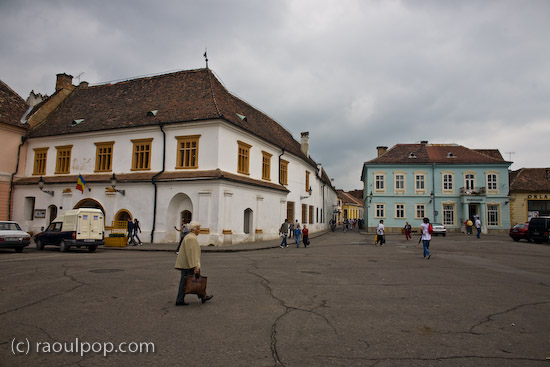
It would be logical to assume that Romania would feel more like home, since it’s where I was born and raised. You’d only be partly correct. Yes, when I go back there, I feel more at home than here. The strings of my heart vibrate at the same frequency as my birthplace. When I’m there, the air is sweeter, the food tastes better, interactions with people are more meaningful, every sensation is accentuated by the vibrancy of my home land. Sleep is more restful, and life takes on a new, familial rhythm. I feel a peace that I cannot feel here. Yet I do not feel at peace.
There’s the awful rub. In the words of Charles Laughton from the movie “It Started With Eve” (1941), “I’ve been tampered with!” I’ve spent so much time in the States that I’ve grown accustomed to the way of living over here. Not the comfort and abundance of products, though that’s part of it, but the way of life, of doing business, of approaching situations. I no longer fit in, in Romania, and I still do not completely fit in over here, after 17 whole years.

I can function just about anywhere, but am at home nowhere. I’ve got a mongrel heart, a split state of being, and it’s a sad, painful way to go through life, at least for me. A piece of me exists in each country, and I’m forever torn between the two.

It must be even worse for Ligia. She’s only been here for 4 years. She spent her entire life in the same region of the country, in a very close-knit family, among friends and relatives, and the only reason she left all of that was to be with me. It’s probably safe to describe the way she feels every day as home sick. At least she’s lived enough in one country to know which one feels more like home. Although the more time she spends here, the more she’ll bond with this country, till she’ll be just like me, a mongrel spirit.

I think of the pilgrims that came to the new continent from Europe, hundreds of years ago. I wonder how they must have felt, knowing that the likelihood of ever going back to their home lands was next to nothing, and having to face the rough conditions that awaited them in untamed territories. Perhaps the tough lives they led, and the blood, sweat and tears they put into eking out an existence bonded them more to their new homes. Or maybe they sat down on quiet evenings and silently bore pangs of sorrow over the distance that separated them from their birthplaces and ancestral homes.

Then I envy their children, who didn’t (and don’t) have to worry about any of those things. And I yearn for the normalcy and peace which I don’t think I’ll ever reach.

Standard
Reviews

Theodora Goes Wild (1936)

Movie poster for Theodora Goes Wild.

One of the many wonderful comedies made during the Great Depression, Theodora Goes Wild explores a young woman’s quest for freedom in a society where tight constraints are the norm. The film’s humorous and entertaining look at some of the hang-ups of the period is a very fun way to spend about 90 minutes. Interestingly enough, we discover that not many things have changed since. Gossip still rules, small town folk are always too interested in each other’s lives, and people still yearn to live their lives the way they see fit.

Theodora Lynn, a respected daughter of the town’s prominent family, has written a book called “The Sinner”. It’s a wildly successful look at the life of an imaginary woman who does things her own way, very much unlike Theodora. She has penned it under the name Caroline Adams, to protect her identity. Meanwhile, the town is in an uproar over the scandalous morals of the book’s main character, all the while unaware that the very same young woman that plays the organ in church every Sunday morning and obeys her aunts to the letter is the author of said scandalous book.

Theodora visits her publisher on an occasion, and while there, meets Michael Grant, played by Melvyn Douglas, a debonair artist who works for the publisher but is very informal. He takes an immediate liking to her, and coaxes his way into having dinner with her and the publisher that evening. During dinner, he gets her to drink (which she never does) and as she unwinds and lets loose, he enjoys his little game more and more. He decides to pursue her back to her town and “free” her, as he puts it. He succeeds, but he has unleashed a force greater than him. She now intends to “free” him.

The film’s gloriously funny twists and turns had us in fits of laughter throughout. And the skewering of the old biddies in that small town was great fun too! The film showcases Irene Dunne’s incredible talent for comedy and sexiness (it’s no wonder she made such a great on-screen pair with Cary Grant), and fits Melvyn Douglas to a tee. He has an endearing quality that shows through his devilish smirks and his on-screen antics. That same quality made him perfect for the role of Leon in Ninotchka (opposite Greta Garbo) three years later. I can safely say that he’s become one of my favorite actors.

Just one year later, Irene Dunne made The Awful Truth (1937) with Cary Grant, one of my all-time favorite movies. It’s so funny to see her honing and refining the same skills she used to great success in that movie while watching this one. The same little trills of laughter, the same thin smiles, the same looks, glances… It’s wonderful to catch great actors doing some of their best work. It’s time well spent to watch them act.

There’s an important lesson to be learned from the movie as well. It’s easy to forget nowadays how stifling society used to be, and how scandalous certain behaviors were considered just a few decades ago. To some extent, that was a good thing, but it must have driven some people mad with frustration. Nowadays, things are much more relaxed, although we still tend to be judgmental. It seems we always want to tell others what to do and what not to do. Sure, it’s important to point out what’s morally and ethically wrong, but that’s the duty of our parents and families, NOT our neighbors and townsfolk. I don’t believe in the saying that “it takes a village to raise a child”. No it does not! That sort of a village would be the quickest way to get me to rebel if I were still a child.

It’s also important to point out that while Theodora rebelled against the gossipy old biddies and against society, she did it all with a purpose, all while not compromising her own morals. She did not demean what she saw as her true worth. She simply put on a show to prove a point, and she certainly proved it. That’s something to keep in mind for the young people of today, who are so ready to step over any rules they might have set to get at what they want. Sometimes there are horrible consequences to that sort of behavior. If you watch the movie, you’ll remember that Theodora kept “both feet on the ground”. Keep that in mind. Have your fun, achieve your dreams, prove your point, but don’t do something you’d later regret.

More information

Standard
Thoughts

Scary stuff is happening in China

As I look at these truly scary images of pollution in China, I realize how big a problem pollution really is over there. For most of us, China’s this big country over there in Asia, sort of communist but not really, with plenty of human rights abuses under its belt, but still more decent than other communist countries like North Korea. We also know it as the place our products (toys, computers, clothes, etc.) come from. Well, it’s high time we got to know as the place where incredible pollution exists, and it’s as much our fault as it is theirs.

As consumers, we’ve happily accepted the lower-priced products made over there, because we can buy more of them, more often. As companies, we’ve happily moved our factories over there, because the labor was cheaper and the environmental laws were almost non-existent. China itself was only too happy to receive our business. They got an incredibly influx of money, expanded their economies and gross national product through the roof, got a middle class and a very wealthy upper class, and started walking out of the darker stages of communism toward something that might be called “capitalism light”.

Along the way, people all around easily closed their eyes or winked at the horrible pollution that was accumulating around them, poisoning China’s air and water and earth and cities. They reasoned that it was the price to pay for progress. They chalked it up to growing pains.

Well, it’s hard to close our eyes any more. Not after you see those photos. Don’t worry, they’re not the only photos available. There is plenty of proof of the damage that’s occurred there. And it’s scary. Very scary.

China is a very sick country. It’s very polluted. It’s incredibly polluted. I don’t know if it’ll ever fully recover. The damage has been done, irreversibly. Yet we all keep on going ahead, full steam, in a mindless race toward certain disaster, motivated by corporate greed and consumer lust for more shiny toys.

It has to stop. This will come back to bite us, right here in the US. It’s guaranteed.

Part of the solution is willing to live with “upgradeable” products. Instead of buying a new computer, send the old one in to get new, faster parts put in the old enclosure. Instead of throwing away a toy, donate it if it can still be used. Same with clothes. Don’t throw them away, give them away. Furthermore, Truly gigantic recycling efforts must be put forth, like the Japanese are doing. Every kind of plastic must be recycled. All metals must be reclaimed and reused. Poisonous chemicals must be contained. This is serious stuff.

Recycling efforts in the US are half-assed at best. Let’s face it, if the best stuff we can come up with from recycled plastic is park benches, then we’re screwed. If our answer to reducing environmental pollution is sending our used computer equipment to China, where it piles up by the mountains, we’re screwed. If companies’ answer to societal needs is to create crappy designs that age in months and practically scream “throw me away”, then we’re screwed. If we do nothing, we’re all screwed.

Standard
Thoughts

Hot teachers and sex with students

Three more female teachers have been jailed after it was discovered that they had sex with students in Tampa, FL. MSN has a video report on this. Plus, if you do a search on MSN Live, you’ll get plenty of search results summarizing recent news stories about similar events.

What bothers me about these reports is that the boys in question are always categorized as “abused”. It’s a great example of societal hypocrisy. To those that say that, I say this: BS! Seriously, does any male in their right mind think these boys were abused? Young boys practically swoon and fawn over attractive female teachers. It’s been going on for ages. They fantasize, and they do “other things” as well to “cope” with those crushes. So when these boys — in spite of what they might say now to the authorities — had the chance to engage in those sexual encounters, do you think they had doubts for even a second? Not a chance. Seriously, have these adults trying the women’s cases forgotten their own childhoods?

Sure, those boys will deny it now, and agree that they were corrupted, and to some extent, I agree with that characterization, as you’ll see below, but they engaged in the encounters willingly, happily and repeatedly. Given the chance to do it again, they did it and still would do it again. They went back for more, time and time again. In the case of one of the teachers, she had an orgy in a hotel room where more than 10 teens were in “attendance”. That is not abuse. That’s really slutty behavior on both sides.

Look, don’t get me wrong. I agree that the teachers did something unethical. They abused their position of authority as teachers, and they corrupted the normal teacher-pupil bond by engaging and participating in those situations. Furthermore, it was morally wrong to start an adult-level relationship with a child, in spite of their physical maturity. From a religious point of view, what they committed was adultery, and that’s clearly wrong. But we need to look at this objectively, from a civic point of view.

We should look at how much damage was caused to what we call the “victims”. It’s possible that the teachers corrupted the boys, in the sense that they introduced them to sexual situations that boys don’t normally encounter. One’s perspective in life changes once one has had those sorts of experiences. They will look at sex differently. They will look at relationships differently.

Then again, it depends greatly on how those teachers approached the situations, and how the boys viewed the encounters. In the context of “love”, not sex — and suspend for a moment the disbelief that love can exist when the age disparity is so great — it’s quite possible to have a healthier outcome, whatever that means. There are varying degrees of perception, and they depend on each individual. One must ask how ready the boys were, physically and mentally, for such an experience, and how much mutual respect there was in each “relationship”, etc… It’s a gray area, and it needs to be looked at as such. Clearly in the case of the hotel room orgy, there was no respect or “love”, simply animal sex, and that should be looked at as corruption of a minor (or rather, multiple minors).

If one is to look at this as a black and white situation, was there sex with a minor? Yes. Should it have taken place? No. Should the standard punishment apply? NO. This is not typical sexual abuse. The boys weren’t coerced. They enjoyed it, every minute of it. They went back for more. They probably bragged to their friends, etc… These are all attenuating circumstances.

In the grand picture, are these situations going to create more long-term sequelae for the boys than any of the following situations:

  • A young girl who has consensual sex with her boyfriend, but then finds out he is calling her a slut to all his friends, and is bragging about having “bagged” her, etc.
  • A young boy who has consensual sex with his girlfriend, but then finds out she is making fun of his naked body, or the size of his… manhood, or about the sounds or face he made during sex, etc.
  • A young boy or girl who are convinced by their “friends” to experiment with same-sex encounters when they’re not really interested, just questioning themselves.
  • A young girl who is forced into sex by her boyfriend, but is too ashamed to admit it afterwards.
  • A girl who is slipped a mickey or gotten drunk at a party, then gang-raped by classmates or friends while she’s unaware of what’s going on.

What happened to these boys is peanuts, literally. Yet all these “offenders” described in the bullet list above would not be prosecuted under law. Seriously, I think any one of us has either heard of “gray-area” situations like these, or experienced them in person. I can practically guarantee you that the boys and girls who have gone through the situations I described above will have more sequelae and will experience more long-term trauma than the boys who’ve had sex with their teachers in recent news. It’s pretty much a given. Yet which situations are getting more attention? These ones? Why? Because it makes it easy for prosecutors to look good. And it makes for good news. That’s why. And it’s hypocritical.

I could go on and on and talk about situations that are much worse than that, like serious rape cases, or sexual torture, or sexual mutilation. These are much more serious, yet in terms of news coverage and severity of punishment, they’re simply not getting the attention they need. In some cultures, like Africa, female circumcision, a form of sexual mutilation, is condoned and accepted by society.

Right here in the States, I’ve heard of a case where a girl was repeatedly raped by her father from an early age, with her mother’s permission. To this day, the girl cannot bring legal charges against her parents. I’ve also heard of a girl who was loaned out (prostituted) to perverts by her mother from the age of 3, in exchange for drug money. That sort of stuff is is really screwed up. That should be the stuff that gets obsessively prosecuted. Instead, we have rapists that can get away with only a few years’ punishment, then get out and rape again and again, while these teachers in the news right now are put through the works for doing something that was pretty much consensual.

Everyone is now rushing to pronounce the verdict and crowd around the “victims” when there are countless other real victims all around us that are getting no positive attention at all. I say look at each teacher-boy encounter individually, mete punishment in accordance with the gravity of the crime, keeping in mind the attenuating circumstances, and if some of those situations only deserve a slap on the hand for the teacher, let’s be honest enough to admit it, as a society. And let’s also be honest enough to admit when a crime is heinous enough to deserve the death punishment (don’t get me started on that).

Standard
Lists

Condensed knowledge for 2008-03-19

Standard