Reviews

WD TV is better than Apple TV

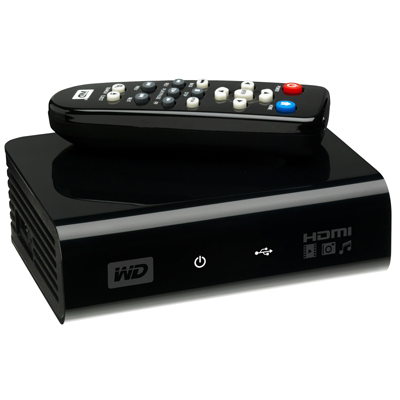
WD has put a new device on the market, and it’s called the WD TV HD Media Player. It’s a small box that can connect to a TV via HDMI or Composite output cables, and can take most USB external hard drives as input (it should even read USB flash drives as long as they’re formatted in FAT32). Once a device is connected, the WD TV will read the media from that drive (movies, photos, music) and let you browse through them and play them on your TV. What sets this device apart for me is that it has gone beyond other similar devices like the LaCinema Premier, or Apple TV. I’ll explain below.

The LaCie product, for example, doesn’t play as many formats as WD TV, and can only support NTFS and FAT32 file systems.

You’re limited in the amount of content you can play with LaCinema Premier, since the drive is integrated within the device itself, and because not as many video formats are supported (see the specs on the LaCie website). That means you have to lug the whole thing from your home office to your living room, re-connect it at each place, and copy files onto it when you want to refresh its inventory. The remote also leaves something to be desired (too many buttons).

I know and like Apple TV myself, having bought one and configured it for my parents, but frankly, I find it overpriced and under-featured. The more you use Apple TV, the more limitations you find:

  • It has an internal hard drive that syncs with content over a wireless network, which means you have to wait forever to get a movie onto it. The drive can also fill up quickly, depending on which size you pick. (Yes, you can also connect it via a Gigabit network, if you’ve pre-wired your living room and home office with Gigabit wires already — but most people have not.)
  • You can stream to it, but then you always have to keep iTunes open, and it’s a hassle to remember that, especially when you’ve just sat down on the living room couch and turned on the TV.
  • You also need to be able to troubleshoot WiFi issues in case you’re not getting enough bandwidth and Apple TV playback stutters.
  • You have to add every single video clip you want to play on Apple TV to the iTunes library, and I don’t care for that sort of thing. I just want to store my stuff in folders and browse it from a device (like WD TV).
  • Apple TV has a USB port on the back, but you can’t use it for anything but “diagnostics” unless you hack the device. This is stupid. I can’t use the port to connect Apple TV to my computer and copy content onto it, I can’t use it to connect an external hard drive to it and have it read the content from it (like WD TV), and it just sits there, unused, unless I pay for a hacking device like aTV Flash.
  • It overheats like crazy. It can burn your fingers if you’re not careful.

I love the design of Apple TV and its diminutive remote. I love the fact that I can swap remotes between it and my laptop if I want to. I think the on-screen menus are well done. I also like the fact that it can stream Flickr photos and YouTube videos, but these extra functions are just that: extra-neous. It simply cannot do its basic job well, and that is to play my media conveniently.

I’m not alone in being frustrated with it. Thomas Hawk has written repeatedly against Apple TV, and for the very same reasons I describe in this post. Steve Jobs recently said he’s not sure what to do with Apple TV. He’s treating it like an unwanted step child. It’s not listed in the Mac product lineup on Apple’s website. It sits off to the side in a section of its own, and you have to do a search for “Apple TV” in order to find it. Corrected 11/11/08: It’s listed in the iTunes and More line-up along with the iPods.

For one thing, Mr. Jobs, you can stop being so greedy in your approach to the device and let people use the USB port on the back. Or how about letting people stream Netflix videos with it, so they don’t have to buy a separate device? I’m a Mac user and have a Netflix account. Until Netflix release Roku and opened up its streaming program to Mac users, I was in the dark. You probably don’t want to do these things because it’ll cut into your video rentals and purchases, and you like that extra revenue stream, but the fact remains that sales of the device will always remain low if you insist on hamstringing it.

The WD TV Player, on the other hand, is made to suit most people. It has a USB port where you can connect most external hard drives. It will read NTFS, FAT32, and HFS file systems too. (I found that out from WD Support, because the info isn’t listed among the specs. They pointed me to KB article #2726.) There seems to be an issue with HFS+ file systems, but they’ll still work, only differently. I’ll have to look into that later.

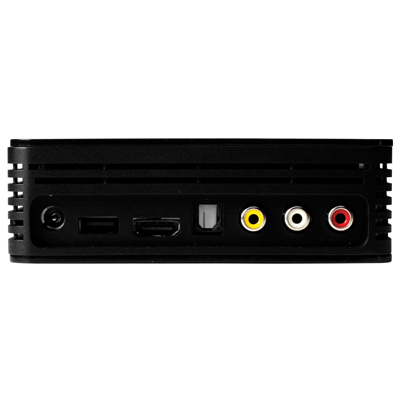
Also not listed among the specs is an Optical Audio port, but when I look at the back of the device, it seems to me I can see one there.
To me, WD TV is the long-awaited answer to my media player needs. At around $99 (street price), this is one device that will make its way to my Christmas stocking pretty soon, because I’ve got a Drobo full of content I’d like to play my way, not to mention that I also have two WD Passport drives.

I may even get one for my parents, to replace their Apple TV. They’ve had to keep their Drobo connected to their iMac in the home office, with iTunes open, all this time, just so they could watch a movie or two from the Drobo. That’s not right. Once I get the WD TV, I can take their Drobo, put it in the living room, and hook it up right there, without worrying about WiFi, streaming, iTunes, and a whole bunch of nonsense. Apple dropped the ball with Apple TV, and WD picked it up and started running with it.

The WD TV supports the following file formats:

  • Music: MP3, WMA, OGG, WAV/PCM/LPCM, AAC, FLAC, Dolby Digital, AIF/AIFF, MKA
  • Photo: JPEG, GIF, TIF/TIFF, BMP, PNG
  • Video: MPEG1/2/4, WMV9, AVI (MPEG4, Xvid, AVC), H.264, MKV, MOV (MPEG4, H.264). It will play MPEG2/4, H.264, and WMV9 videos up to 1920x1080p 24fps, 1920x1080i 30fps, 1280x720p 60fps resolution. That’s awesome.
  • Playlist: PLS, M3U, WPL
  • Subtitle: SRT (UTF-8)

I plan to get one soon, and I’ll let you know in this post if it lives up to its specs and my expectations. If you’d like to get one too, Amazon lists them. See below.

You can buy the WD TV Player from:

Standard
Reviews

Funny comics for sucky times

These “fun” times we’re living in call for some cheering up. I’m subscribed to these following comics (listed in alphabetical order), and they put a smile on my face each and every day:

Basic Instructions by Scott Meyer

Geek and Poke by Oliver Widder

Kawaii Not by Meghan Murphy

What The Duck by Aaron Johnson

Wondermark by David Malki ! (yes, the exclamation sign is required)

xkcd by Randall Munroe

I’ll let you discover what each one is about by visiting their respective sites. Enjoy!

Standard
Reviews

I like Snapple Lime Green Iced Tea

Not much to say other than I like it. I had it this past week, and it’s got a nice, refreshing taste. I already like green tea anyway, and if you’re going to flavor it with lime, then sweeten it just right, I can’t say no. Oh, and it’s definitely much better than this stuff.

Standard
Reviews

Camera preview: Canon EOS 5D Mark II DSLR

I’m a little late to the table with my thoughts on the new 5D, but I have an excuse: I’ve been traveling abroad (see this, this and this) and only now managed to sit down and think about it. There’s also an advantage to this: I got to read through the other reviews that have come out before I wrote mine.

So, what sources did I consult?

  • The Canon website was the first place I looked. There’s the official press release for the new 5D, and then the 5D Mark II pages. (I looked at the press release back on September 20th, when it came out.) Canon has also published 1080p HD video clips shot with the new 5D on their website, and they’re definitely worth checking out. They make a point to specify that the clips were shot with a pre-production 5D Mark II, so they may not accurately represent the quality of the production camera.
  • Digital Photography Review put together a very detailed review of the new 5D, as usual. Their review was very helpful to me.
  • The Online Photographer talked about the quality of the 5D’s HD video, and he brought up a good point. I’ll mention it here because I felt the same way when I saw Vincent LaForet’s video: it just wasn’t very good in terms of realization. It didn’t tie together, it felt empty… In a way, this was to be expected when there were only two days to write it, produce it, film it and edit it. But the quality of the video from the 5D Mark II was definitely worth seeing.
  • Robert Reichmann from the The Luminous Landscape posted pre-production video shot with the new 5D and gave his first impressions of the camera. He was in a hurry as well, as he was leaving for a trip to Africa and had only 48 hours with the camera. He says that the video is very high quality (so high that MBPs playing the full resolution video will skip frames), and there is no jellocam effect, where you see balooning artifacts due to slow recording of the data by the CMOS.
  • PopPhoto chimed in with a quick preview that did a little feature comparison between the old and new 5Ds.
  • On Taking Pictures had an interesting first reaction. He pointed out that the AF system should have been improved. It’s still the same 9-point AF found on the original 5D, and it has its limitations, as I can attest.
  • Thomas Hawk wrote up his impressions. He’s excited and plans to get one as soon as they’re available.
  • I found out about a new review aggregation site while I was writing this post. It’s called TestFreaks, and it’s one of the places where I looked for other reviews of the 5D. So far, they’ve posted links to four reviews for this camera, out of which an Italian review was worthwhile, particularly their side-by-side comparison of the old and new 5Ds. The rest of the linked reviews simply spewed the press release, which involves no effort or thought whatsoever. But I think the site is useful as a place to check for reviews when you want to learn more about a product.

What about me? Well, I wrote about the original and new 5D back in August 2007, when I took a shot a predicting the features of its new iteration. And I also wrote another article a little over a month ago, on August 28, where I talked about the coming convergence of DSLRs and video, and predicted that after the launch of Nikon D90’s 720p HD video capabilities, 1080p HD video wouldn’t be far off. Amazingly, Canon had already been at work on that very same feature, and launched it with the new 5D shortly afterward.

Let me first indulge myself and see how right (or wrong) I was in my own predictions about the 5D Mark II:

  • EOS integrated cleaning system (YES)
  • Live View (YES)
  • 16 Megapixels (NO, even better)
  • Up to 3200 ISO (NO, even better)
  • Increased battery life (YES)
  • Weatherproofing (YES)
  • AF upgrade (NO, unfortunately)
  • Increased zones for exposure metering (YES)
  • Shutter durability up to 300,000 cycles (NO, but still increased to 150,000 cycles)
  • 3″ LCD (YES)
  • Retail price $3,300 (NO, it’s $600 lower)

What I did as I read through the official specs found on Canon’s website and through the other reviews was to take notes of the interesting differences between the original 5D and the new 5D.

Original 5D 5D Mark II
12.8 megapixels (4368×2912 pixels) 21.1 megapixels (5616 x 3744 pixels)
DIGIC 2 processor DIGIC 4 processor
12 Bit A/D conversion 14 Bit A/D conversion
Pixel size 8.2 μm Pixel size 6.4 μm and reduced microlens gap
Native ISO capabilities 100-1600;
expanded capabilities 50-3200
Native ISO capabilities of 100-6400;
expanded capabilities 50-25600
Frame rate 3.0 fps Frame rate 3.9 fps
Shutter life 100,000 cycles Shutter life 150,000 cycles
Full HD (1080p) movies encoded with H.264 codec and PCM sound;
1080p movie mode (1920×1080) records clips up to 12 minutes;
480p movie mode (640×480) records clips up to 24 minutes;
Single file size (for movie clips) is limited to 4GB
No internal microphone/speaker;
No microphone input socket
Has microphone input socket to record higher quality audio for video files;
internal microphone on front of camera, and built-in speaker on back of camera
Viewfinder coverage 96% Viewfinder coverage 98%
Can use infrared remotes
Battery BP-511A;
up to 700 shots per charge;
1390 mAh
Battery life LP-E6;
up to 850 shots per charge;
1800 mAh
No additional batter info other than remaining charge improved battery status displayed on screen; camera can memorize batteries by their S/N and show you exactly how much power you have in each one.
RAW shooting enabled in Auto mode
Exposure bracketing +/-2 EV Exposure bracketing up to up to +/-4 EV
Creative Auto mode makes depth of field and exposure adjustments easier (for those that don’t bother to learn the basics…)
Auto Lighting Optimizer evens out harsh highlights and strong shadows
Peripheral Illumination Correction minimizes vignetting effects
Can embed copyright info but not intuitive at all Easier embedding of copyright info and photographer name in each photo taken with camera
Accessory shoe painted black, which leads to paint scratches as speedlites are mounted to camera Accessory shoe now left bare (metal-colored), which is better
2.5″ LCD, not very good at all in sunlight, low resolution 3″ LCD, great in sunlight, high resolution
Uses CF Type I and Type II cards Uses CF Type I, Type II, UDMA and CF+ cards
Auto ISO (100-3200);
can be turned on everywhere but in M mode, which is the way it should be
AF microadjustment
Live View with three AF modes: passive (mirror flips down briefly to focus), contrast detection (mirror stays up) and face detection (self-explanatory)
No water resistance, although I have taken my 5D out in the rain and it did fine as long as I didn’t get it completely wet Water resistance (10mm rain in 3 minutes)
Some dust resistance
2.5″ LCD, not very good at all in sunlight, low resolution 3″ LCD, great in sunlight, high resolution
No Quiet Shooting mode;
mirror slap is pretty loud
Quieter shooting mode available;
mirror will either lock up, or it will move slowly to the halfway position and close normally from there, creating less noise

How could the new 5D be even better?

  • AF should have been upgraded to something faster and more accurate
  • RAW files still CR2 format; it would have been nice to standardize on the DNG format
  • Color space options are still only sRGB or AdobeRGB; what about ProPhotoRGB?
  • HDMI Out miniport puts out great video but NO audio, which is unfortunate
  • Hand grip now slightly thicker, but space between grip and lens barrel slightly smaller, which means you may end up jamming your fingernails into the lens as you hold the camera, should you have thicker fingers. This was a point of contention with the 30D, was addressed in the 40D, and now I see it potentially coming back (though to a lesser degree) in the 5D Mark II.
  • No controls for video other than focus and exposure compensation once you start recording. It really does seem like the video mode was grafted onto the camera, as Luminous Landscape puts it in their review. Plus, the microphone input socket isn’t a pro-level socket, but a plastic one that can easily break if you’re not careful.
  • Recording video will drain the battery a LOT faster than shooting photos. And it will take up space. You’ll go through a single 4GB CF card in about 11-12 minutes if you’re shooting video. I guess this is to be expected given that the camera records full HD video on a huge 35mm sensor.

On the plus side, it’s interesting to note that I paid $100 more for my original 5D back in April of 2007 than what the new 5D Mark II will cost at retail when it hits the market. I bought my 5D for $2800 from Costco, and the new 5D will cost $2,700, but it will have all these incredible new features. Something to think about. I suppose I shouldn’t complain, since I did get about 1 1/2 years about of my 5D before it was rendered outdated by its successor.

So, will I be getting one? Not at the moment, no. My original 5D is still very usable, and I don’t have the deeper pockets of some other folks. I’m still without a good zoom lens. Coincidentally, the same great zoom lens that I like (EF 24-105mm f/4L IS) can be bought as a kit lens with the new 5D, so I definitely encourage you to get it if you don’t have it in your inventory. It will prove its versatility over time, and you will be glad you have it.

At some point in the future, I will be glad to buy the new 5D. Perhaps by that time they’ll have made the video mode more streamlined, and integrated it a little better within the menus and external buttons of the camera, not to mention that I’ll have had a chance to save up for it.

If you’d like to get it though, don’t let me stop you:

Photos used courtesy of Canon.

Standard
Reviews

A Dell order and return experience

On 7/31, I placed an order for a Dell S2409W 24-inch Widescreen Flat Panel LCD Monitor, a new model from Dell which has a 16:9 display ratio and runs about $350. I needed an external display for my MacBook Pro, because it’s getting cumbersome to edit photos on a 15″ screen.

On 8/21 (three weeks later), it finally arrived. After connecting it to my Mac, I discovered it just didn’t have the display quality I needed, and started thinking about returning it.

A couple of days later, after I tested it and calibrated it as much as I could, I filed a request for a Return Authorization on Dell’s website. I had to fill out a form with all of the order information and with my address (which I had to enter twice), because the website isn’t designed to pre-populate the fields based on the information already present in your account. There is a way to log in, which promises to pull that information for you, but even if you do log in, nothing gets pulled. You can’t just go to an order and click on a Return option.

I got an automated confirmation right away which assured me they are “working 24 hours a day, 7 days a week, to answer customer inquiries”, and that I could expect a response in “24 hours or less”.

Their response did not arrive within 24 hours. When it did, it said they are “unable to process a return authorization for the order,” and to “please contact Dell Consumer Customer Care at 800-624-9897.” I called them.

I was greeted by the Dell phone robot, and followed the various prompts to navigate the menus, until it was satisfied and passed me off to a real person. That’s when the fun really began.

Rep 1 (Indian): “Could I have the order number? What is your name? How can I help you?”
Me: “I’d like to return that order.”
Rep 1: Okay, let me connect you to someone that can help.”

Rep 2 (Indian): “Could I have the order number? What is your name? How can I help you?”
Me: “I’d like to return that order.”
Rep 2: “Okay, let me connect you to someone that can help.”

Rep 3 (Indian): “Could I have the order number? What is your name? How can I help you?”
Me: “I’d like to return that order.”
Rep 3: “Okay, let me connect you to someone that can help.”

Rep 4 (American): “Could I have the order number? What is your name? How can I help you?”
Me: “I’d like to return that order.”
Rep 4: “Why?”
Me: “Display quality is not satisfactory when connected to a Mac.”
Rep 4: “Have you tried to adjust it?”
Me: “Yes, but it just won’t display colors the way they need to be displayed.”
Rep 4: “Do you have a video card?”
Me: [Couldn’t believe what I’d just heard… Pause] “Of course, otherwise my computer wouldn’t work.” [Which is true — to my knowledge, you need either a graphics card or an embedded graphics chip to display video with a normal computer, and besides, they don’t ship Macs without some sort of video cards.] “Look, I just want to return the order…”
Rep 4: “Okay, I wanted to make sure, because you’ll be charged a 15% restocking fee.”
[Then she got to work on processing the Return Authorization and issued it to me.]

I spent 19:06 minutes on the phone to get the Return Authorization, and had to go through all of that stuff listed above. I’m not counting the time spent digging on the Dell website to submit the web request, which obviously didn’t come to anything.

You would think:

  • Dell would want to make it less onerous for its customers to get their business done when they deal with them over the phone.
  • It’d take less than four people to get to the right person.
  • I wouldn’t have to speak to three Indian reps at some call center in India, then get transferred to an American rep somewhere here in the States, before someone could address the reason for my call.
  • Someone who processes RMAs wouldn’t try to troubleshoot a product, especially when I’m not interested, and when they don’t know how a computer works.
  • Dell would have a way to pass the order number and customer name from rep to rep, so I wouldn’t have to say them over and over and over.

You’d be right to think all those things. Unfortunately, every time I interact with Dell, I see that they still don’t have their act together. They’re too big, disorganized, they don’t treat their customers properly, and they make it a hassle to deal with the company. As for their design philosophy, it’s practically non-existent, unless making ugly stuff counts — except for their recent Studio laptops and Studio Hybrid desktops. Is it any wonder they’re not doing so well?

And what’s up with the 15% restocking fee? I thought the industry “standard” was 14%.

Standard