Places

Dawn over the Atlantic Ocean

This will be my 1,000th post, so perhaps it’s fitting that it be this: photos of the dawn, breaking high above the clouds, somewhere near the coast of France. It symbolizes a new beginning, a milestone — although I have to confess it came by surprise. I hadn’t monitored the number of posts for a while. By chance, I glanced at it yesterday and saw the fateful sum: 999. That’s when I knew I had to make this 1,000th post a little more special than the rest.

We were on our way to Paris from Washington, DC, on board an overnight Air France flight. We were going to have a short layover at Charles de Gaulle airport, then fly to Bucharest, where a rental car awaited our arrival. From there, we’d drive north, crossing the Carpathian Mountains to reach my grandfather’s house in Transylvania.

I liked Air France. The chairs were fairly comfortable, there was more space between the rows than on Austrian Airlines, and all of the seat gadgets worked, which was very unlike Alitalia (see paragraph 7 of that post for the details). The food was great, they got our menu selections right, the stewards and stewardesses were friendly and polite, and we had a good experience overall. I would fly with them again.

I hadn’t slept much all night. I can’t sleep very well on airplanes — I should probably say I can’t sleep much at all on airplanes. There’s the noise, then, of course, the “wonderful” seats and the lack of humidity, etc. I usually watch movies to pass the time while I gasp for air and pour water down my parched throat.

Outside, pitch black darkness stared back at me, and the faint reflection of a bleary-eyed traveler bearing my resemblance was visible in the window. Had there been no one around, it would have been eerie. But Ligia was next to me. She was sleeping somewhat peacefully, and that comforted me.

As morning approached and the first rays of light began to break through the darkness, Ligia woke up. I took out my 5D, and stood ready for that fleeting moment when color and light would combine to produce something worth capturing. Here it is.
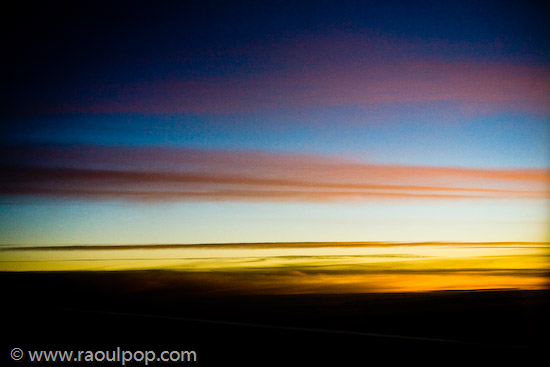
Dawn breaking

At 33,000 feet, the cloud clover stayed below, and only its remembrance remained, in the shape of wispy lines that traced alongside us.

I kept my camera ready in case other opportunities presented themselves, and I wasn’t disappointed. A supersonic jet passed by us, leaving orange-yellow contrails in its wake.

Jet set

No matter how commoditized flight gets, there are still a great number of people that can never afford to experience it. I suppose that has its pluses and minuses. On the plus side, enough pollution is generated by existing airplanes, so perhaps it’s better that their number is kept somewhat limited. On the other hand, many opportunities open up to you when you can travel so fast. Trips that take days suddenly take only hours. Life, for better or worse, gets faster, and you can do more. I suppose that can be both good and bad, depending on your point of view. I’m on the fence about it myself.

The rarefied life

We found ourselves in our rental car, driving toward Transylvania, that afternoon. We drove through the evening and part of the night. Road repairs made our trip unnecessarily long, but that’s a story for another day. As we were driving through the Carpathian Mountains, night set in, and I stopped to take this photo.

A closing account

As we paused to rest, we thought about the last 24 hours. In that relatively short span of time, we’d traveled over 4,000 miles and still had a few more to go.

Life moves fast these days. If we’re not careful, we can end up old and tired, having spent a lifetime running around from place to place. Sometimes it’s worth more than we know it to STOP, even if it’s only for a few minutes, and look around us. That’s when we realize that those few moments of pause are more precious than whole days of nonstop action.

Standard
Thoughts

It’s about expectations

Many of us have heard this before, but it bears repeating. Customer or user satisfaction depends, in large part, upon the expectations you set, as a service or product provider. Promise something you can’t or don’t deliver, and satisfaction goes right down the drain, no matter what you did right.

A great friend of mine put this another way: under-promise, and over-deliver. It’s plain, simple, and it should be the golden rule that companies use when they think about their products and services. I don’t mean you should set your sights on mediocrity, or that you should settle for the lowest common denominator. But you should ALWAYS make sure you promise only what you can absolutely deliver, and if you do anything above and beyond the call of duty, it’s icing on the cake, and it makes the customer ecstatic in a viral sort of way.

Have you heard of Micro Center? Neither did I, till a couple of weeks ago. Their website is certainly underwhelming — at least it is at this point in time, but I have a feeling that’ll change. I got a flyer in the mail from them, inviting me to the store for a free gift. I went in and was blown away. Their store has the coolest and best floor layout I’ve ever seen! It’s clean, well-lit, beautiful, stocked to the gills with cool technology, and everyone is friendly! Did they promise any of that in their flyer? No, they just promised the free gift and mentioned the new store. They delivered on the free gift just fine, and their store atmosphere was the icing on the cake that left me ecstatic.

And guess what? They have an in-store pickup option as well. I ordered a few CF cards from their site today, and went to pick them up in the evening. But do you know what they did? They didn’t promise a 20-minute turnaround. They actually put some thought into it. Their staff is new, their store is new, their systems are probably new or re-designed, and they knew they couldn’t deliver on something like that. They said the order would be ready for pickup in a couple of days. Was I disappointed? No. I got the price I wanted on the products I wanted, and as long as they were going to make good on their promise, I didn’t care. But I thought I’d test the waters anyway, and Ligia and I got in our car and drove to the store tonight.

When we got there, the same cheery atmosphere awaited us. The people were courteous and smiled, just like the last time we visited. We went to the customer service counter, where the representative looked up our order and explained that it wasn’t ready yet. No problem, I’d expected that. I asked if I could pick up the items from the store shelves and come back to the counter. She said yes. I browsed through the store, found what I needed, brought the stuff back to the customer service counter, and the representative fulfilled the order. She fiddled a bit with the computer system since it was new, but she was courteous and helpful, and I didn’t mind waiting an extra couple of minutes. In the end, I walked out with my order fulfilled, and the kicker was this: the price was the same as on their website.

It’s about setting the right expectations, plain and simple. Do what works for you, and more importantly, do what you know you can do! Under-promise, over-deliver, and you’ll have happy customers. Even if you go just a bit beyond what you promised, it makes a huge difference!

Standard
Thoughts

Photography, take two, part two

I continued to work on replacing photos hosted with third party services. The list of modified posts is provided below. This has proven to be a huge effort. I had to locate the photos in my digital library — not all of which is keyworded yet, though I’ve got location information for all my photos — but I also chose to re-process, keyword and re-title the photos. You see, most of these photos were keyworded through bulk uploaders, for the purpose of displaying that data on third party photo sharing sites, not for my own library. Clearly that effort was wasted, but I didn’t know that back when I did it… Where applicable, I am also re-writing some of the text.

I want to make sure that the content I provide here at ComeAcross is truly top tier, as much as possible. What does that mean? Well, it means I spent my entire weekend, including Monday, working on the posts listed below, and on the posts listed in part one. I still have more posts to go. I don’t mind doing this — actually, I look forward to it — but I do hope that you, the reader, appreciate the effort that goes on behind the scenes. 🙂

Also see Photography, take two, part one.

Standard
Thoughts

Photography, take two

Over this weekend and the last several days, I’ve gone through posts that contain photographs, and replaced all of the images with ones hosted directly at ComeAcross. In the past, I’ve used photos hosted with third party photo sharing services, and I realize now that’s a folly.

If a third party service goes down, which is very likely with beta services, my photos become unavailable. Even if that service is not in beta, a simple action like closing one’s account shuts down access to all of the photos uploaded there. It’s much more practical to host the photos together with my website. That way, I am fully responsible for making sure that all of my content is accessible. If something goes down, I can take care of it. If I need to change web hosting providers, I simply transfer all of my files over to another server.

It’s not as simple to transfer one’s content with photo sharing services, no matter what they may promise. Image and meta data portability is still not 100% there, and it doesn’t help when a photo sharing service advertises their API’s availability for more than a year, yet fails to put it out for public use. It also doesn’t help when said portability is rendered useless by the amount of compression used on the uploaded originals, or the deletion of meta data embedded in the originals…

You see, everyone is ready to promise the world to you when they want to sell you on something. Quite often, that “world” is nothing more than an empty little shell. I speak in general terms here, from the things I’ve learned through my various experiences — mostly recent ones…

At any rate, I’ve still got to modify a number of posts, but I thought I’d point out the ones I’ve already worked on. They’re quite a few, and I’m happy with the results so far. Here they are:

Also see Photography, take two, part two for more updated posts.

Standard
Reviews

Lens comparison: EF 24-70mm f/2.8L Zoom vs EF 24-105mm f/4L IS Zoom

Have you ever wondered how the EF 24-70mm f/2.8L and EF 24-105mm f/4L zoom lenses would do if compared side by side? Which one would come out as the winner in real-world use? Here’s my answer to that question.

First, some recommended reading:

Those two reviews of mine should give you a good idea of what each lens can do. Now let’s talk about how they do when they’re together. 🙂 Here’s a photo of the two lenses. As you can see right away, the 24-105mm is smaller in both height and girth — it’s shorter and a little narrower than the 24-70mm.

When we look at the rear lens elements, we can see some differences there as well. The 24-105mm lens is on the left. If you look carefully, you can see a baffle in place. The 24-70mm lens has no baffle.

It’s possible that the baffle is there in order to reduce possible flare effects, since the focal range is longer. It could also be there to baffle us — after all, it is a baffle. 🙂 It’s also possible that the optics aren’t as high quality as those in the 24-70mm lens — they’re both priced the same, but the 24-105mm has image stabilization and an extra 35mm of range. On the other hand, I’ve seen a very similar baffle on the EF 14mm f/2.8L prime lens, and no one can say that the 14mm lens is made with cheap glass. So the more likely explanation is that it’s there to reduce lens flare due to the increased focal range.

(By the way, the baffle can be seen even more clearly in this product advisory from Canon warning about unacceptable levels of lens flare in early builds (2005) of the 24-105mm lens.)

Here’s another look at the lenses side by side, this time with the lens controls visible. As you can see, the only thing that’s different on the 24-105mm lens is that it’s got the IS switch. The controls seemed a little thicker on the 24-70mm lens. As for their durability, I assume they’re both long-lasting since these are L series lenses.

Chances are you can already know that the 24-105mm lens is lighter than the 24-70mm lens. It’s no small difference, by the way. The 24-105mm lens is 670g, while the 24-70mm lens is 950g — that’s 280g of difference! While both lenses extend outward as you zoom, the 24-70mm lens is more top-heavy than the 24-105mm lens, and that makes a big difference in wrist fatigue — the 24-105mm lens is less punishing and can be held comfortably for longer periods of time.

The weight difference is remarkable to me because the 24-105mm lens has 18 elements, while the 24-70mm lens has 16 elements. Canon managed to keep the weight down even though they placed extra glass in there and added image stabilization.

There are some limitations to being lighter and smaller though. The 24-105mm lens’ closest focusing distance is 1.48ft or 0.45m, while the 24-70mm lens’ closest focusing distance is 1.25ft or 0.38m. It also looks like the general consensus is that images obtained with the 24-105mm lens are somewhat softer than those obtained with the 24-70mm lens.

Other than the difference in focal lengths, another obvious difference between them is the maximum aperture. The 24-70mm lens opens up to f/2.8, while the 24-105mm lens only opens up to f/4. That’s a full f-stop difference, or a 2x reduction in the amount of light that can enter the lens. This is where the baffle comes in again. Since the baffle itself limits the amount of light that can hit the sensor in order to reduce glare, it stands to reason that the aperture can’t open up any wider. Even if it did, we’d end up seeing the baffle contours in our photos.

What the 24-105mm lens has going for it is the built-in image stabilization, which, in my experience, more than compensates for the reduced maximum aperture. See the photo below. I took it completely handheld (I didn’t prop myself up against anything) at a shutter speed of 1/15th seconds.

I tried to get similar photos with the 24-70mm lens, and I couldn’t, not without leaning against something to stabilize the lens. The slowest shutter speed I could use was 1/30th seconds with that lens. As I concluded in my previous review of the 24-105mm lens, the image stabilization counts for a lot and makes the lens truly versatile and useful.

While I’m talking about versatility, let’s not forget that extra 35mm of focal range. At close distances (6-15 feet), you don’t notice how much it matters, but when you start focusing on things farther away (30-100 feet or more), you realize how valuable those extra millimeters really are!

Let’s not forget bokeh. Both lenses have gorgeous bokeh, but the 24-70mm produces a creamier bokeh. That’s because it opens up all the way to f/2.8, while the other only opens up to f/4. If you do a lot of close-range photography, in tighter spaces, and you really need that bokeh (portraits, etc.), the 24-70mm would probably be a better candidate. This next photo was taken with the 24-70mm lens.

If you’ve got a little wiggle room and can position your subjects further away from things (walls, trees, background), don’t discount the 24-105mm lens. Its bokeh is right up there with the best of them. Have a look below.

In the end, it really comes down to your own, precise needs. I’ve heard of some people who only carry two lenses in their bag: the 24-70mm and the 70-200mm (both of which I reviewed here). They’re both professional-grade, L series lenses. They’re heavy, but they deliver the goods, and they’re versatile.

For my needs, I’d go with the 24-105mm lens. It’s lighter, has extra range, and has built-in image stabilization. I really enjoyed using it, and I seemed to get better photos with it than with the 24-70mm zoom. While it may not be as sharp, I didn’t notice anything that would turn me away from using it. I thought it was a superb lens and couldn’t believe the quality of the optics when I looked at the photos I got with it.

At least one commenter here asked how these two lenses compare, and I hope that I’ve answered that question in as much detail as I could give. If you have any other questions, pose them in the comments on this post, and I’ll try to answer them.

More information:

Standard