Reviews

Funny comics for sucky times

These “fun” times we’re living in call for some cheering up. I’m subscribed to these following comics (listed in alphabetical order), and they put a smile on my face each and every day:

Basic Instructions by Scott Meyer

Geek and Poke by Oliver Widder

Kawaii Not by Meghan Murphy

What The Duck by Aaron Johnson

Wondermark by David Malki ! (yes, the exclamation sign is required)

xkcd by Randall Munroe

I’ll let you discover what each one is about by visiting their respective sites. Enjoy!

Standard
A Guide To A Good Life

American habits

Slow down. That’s a phrase not often heard in the US. At least not among the people I know. But it’s a notion that’s slowly starting to make more sense.

Americans love to think big and spend big. They want progress on every front, no matter what the cost. In the 20th century, that sort of thinking worked well. It carried us through to the 21st century, where, however reluctantly, I think we’ve got to change the way we operate.

There’s a newspaper article I’ve been saving since June of 2007. It’s about people who overextended themselves in order to keep up with the Joneses, and were paying the price. It’s called “Breaking free of suburbia’s stranglehold“. Even before the real estate bubble burst, sensible people were finding out they couldn’t sustain their lifestyle and stay sane, so they downsized. Each found their own impetus, but they were acting on it. That was smart. I wonder how many people had to downsize the hard way since last year…

How about a more pallatable reference, one for the ADD crowd? There’s a Daft Punk video called “Harder, Better, Faster, Stronger“. The lesson to be drawn from it is found at the end of the video, but to get it, you have to watch it from the start. I’ll summarize it for you here. Don’t be fooled by glitter and glamour. There’s a price to pay for everything.

Paying for it isn’t a new notion. It’s been around for ages. Take “pay the piper“, for example. You look at almost any language, and the idea of everything having a price can be found embodied in certain evocative phrases.

Let’s look at a few more concrete examples:

  • You want a bigger house? There will be a cost for that, as seen above.
  • You want the house of your choice AND the job of your choice? You might have to do some really nasty commuting, and now that gas costs a lot more, you’ll not only pay with your time, but with your wallet as well.
  • You persist in wanting to drive an SUV? There’s a price to pay for that too, and it’s not just in gas.
  • You want a house that looks like a mansion, but you don’t want to think about how things get built? That’s okay, you’ll get a plywood box with fake brick cladding that will look like a mansion and will only last you 20-30 years at most (not to mention that your HVAC bills will go through the roof, literally).
  • You want your meat, particularly your pork? There’s a big cost for that, and it’s measured in incredible amounts of environmental damage and in chronic and deadly health problems for the people who work on the pig farms.
  • You want to keep your computers and lights on all the time at work? You want to keep the temperature at 65 degrees Fahrenheit all the time? Do you want to keep all of your employees on site instead of letting them work from home? As a company, you’ll see increased costs because of your wasteful habits.

These are all hard lessons to learn. It seems the only way to get people and companies to learn to act responsibly is to increase costs. When your actions have a direct and immediate impact on your bottom line, you tend to change your ways in order to stop the bleeding.

It’s a shame it has to be that way, and perhaps at some point in the future, the new way of thinking will be more ingrained in people’s minds, and they’ll think about slowing down, conservation, sustainability and efficiency on a daily basis. Perhaps they’ll realize having a more meaningful life is more important than having a busy life filled with material nothingness.

I’m grateful that at least some are already seeing things the right way. I myself have already started to cut out unnecessary expenses and time commitments, and will continue to do so. I have several more important changes still planned.

If you’d like to do the same, one place to start is a book entitled “Take Back Your Time: Fighting Overwork and Time Poverty in America“. It’ll get you thinking along the right lines, but it’ll be up to you afterwards to make the needed changes in your life.

Standard
Places

The C&O Canal

I suppose I should call this “Trip to the C&O Canal – Part Three”, since it’s the third time I write about the C&O Canal (Chesapeake and Ohio Canal) on my site. Here is Part 1 and Part 2. But it’s certainly not our third trip, because we’ve been there numerous times, during various times of the year.

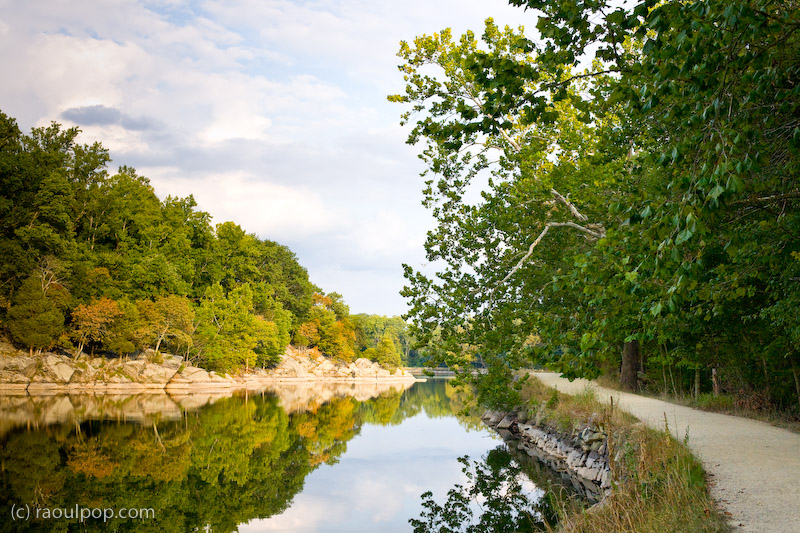
This last time, we did it by bike, starting at Lock 7, which can be accessed from the Southbound Clara Barton Parkway. We traveled past the last gatehouse, which I think was was Lock 12, and past the Carderock Wall, to some section of the canal beyond it.

It’s a lot of fun to bike on the C&O Canal. For one thing, the path that accompanies the canal used to be the old towpath for the mules that pulled the barges, so you know you’re stepping on a piece of history. For another, the canal towpath was built to have no steep grades. Other than little hills that correspond to the drops in altitude at lock gates, the towpath is mostly level, so you won’t get long-winded trying to walk, run or bike up long hills.

As you’ll see in the photos above, some parts of the canal were completely dry. I’m not sure what caused this. Perhaps it was the summer heat, or as you’ll see in a couple of the photos, a sinkhole that opened upstream and possibly swallowed all of the water from those sections of the canal.

The idea for the C&O Canal originated with George Washington, though in another form. Having worked as a land surveyor in his youth, he dreamed of the possibility of making the Potomac River navigable. He thought the only way to do it would be to build skirting canals around its falls. While he was still young, he could not convince the State of Maryland to do this, but after the Revolutionary War, let’s just say it was easier for him to get people to do things.

The Patowmack Company was formed in 1784, and construction began on the skirting canals. Washington himself supervised the construction personally. Beside the canals, channels in the river itself were deepened and boulders were removed. There was a great deal of work to be done, and the work wasn’t finished until 1802, three years after Washington’s death.

Although the canals were useful, the route didn’t generate as much traffic as it should have. For one thing, it was only truly usable up to two months out of the year, due to low water levels. Plus, it was very difficult to get the boats back up the river, because of the current. People ended up dissembling the boats downstream, walking back upstream, and building another boat. This was not efficient nor productive.

George Washington’s idea was interesting, and people kept thinking of a way to capitalize on it. A way to use the Potomac River needed to be found. That’s where the construction of a canal came in. It wasn’t new technology, as that sort of construction was already used in Europe, and even dates back to antiquity.

On November 5, 1823, a convention was held Washington, which led to the chartering of the company that would build the canal on January 27, 1824, and finally, to the start of construction of July 4, 1828.

The construction of the C&O Canal ended in October of 1850 at Cumberland, Maryland. The original plan to extend the canal to the Ohio River had to be modified, because of the extremely hard nature of the work, its slow progression, and financial troubles with the parent company.

Parts of the Canal were opened as they became available, and it worked as a water route until 1924. Frequent flooding closed it for months, and sometimes, for entire seasons, and in 1889, the parent company went bankrupt. It was then taken over by the canal’s rival, the B&O Railroad. In 1902, they even took over the boats. Whereas they had belonged to the people themselves — to the families that toiled night and day to carry goods down the canal — from that year forward, they belonged to the Railroad company…

The B&O Railroad did as little maintenance as possible on the canal, and in 1924, when another flood destroyed parts of it, they closed it down altogether. The canal slowly deteriorated afterwards, until it was taken over by the National Park Service in 1971. They restored the towpath and re-watered parts of the canal.

Here’s an interesting fact [source]:

“Transporting goods and people by canal dates back to antiquity. The lock gates used on the C&O Canal were an adaptation of a design by Leonardo DaVinci in the late 1400’s. Until the advent of the railroad, water travel was far superior to land travel.”

If you’d like more information about the C&O Canal, I recommend the official C&O Canal NPS website. Make sure to use the menu on the left side of the page to navigate through the various sections. It’s a little hard to find your way around at first, but it pays off if you keep digging — there’s a lot of information posted there.

Standard
Thoughts

The shit days of spring

I am pleased to announce that the shit days of spring are approaching their malodorous end. If you happen to live in non-temperate climates, you may not be accustomed with this rite-of-passage period that takes place every year where I live.

The shit days of spring are that time of the year when pig farmers get to spread the joy of their filthy farm by-products throughout the land, at insanely high prices, under the pretense of fertilizing our grounds. It must put a smile on their faces to know that they’re putting the city slickers through the same shitty time they have year-round, even if it is only for a couple of weeks every year. The regret of not being able to make us smell the offal of their filthy beasts all day, every day, is tempered somewhat by the knowledge that their bank accounts are getting fatter, just like their pigs, with every shovel-full of the nasty stuff they throw our way.

Others are in on the fun as well. Landscaping companies throughout the land rejoice every March. This is their own Christmas time, when they get to sell us pig shit at crazy prices. Just how crazy? Friends of ours who own a house told us they were charged $200 per tree for the privilege of having pig shit dumped around the trunk a couple of springs ago. I can only assume the price has gone up since. That’s right, ladies and gents… The going rate is about $200 for two bags of pig shit mixed with wood chips in the DC area. Ain’t that grand?

So it is with a doubly-chagrined expression that I take walks through our community each spring. For one thing, it smells like shit, and not just like cow shit or horse shit, which would at least smell somewhat decent, but like pig shit, arguably the filthiest, smelliest shit on earth. And for another thing, I can’t believe how much us suckers are paying for the damned pig shit. For shit’s sake, shouldn’t it cost less?

At least the shit days of spring are drawing to a close. Trees and flowers are beginning to blossom, and recent rains have flushed away the nasty stuff. I welcome sweet April, and think of Chaucer as I open my windows and can still get a whiff of March’s filthy stank:

“Whan that April with his showres soote
The droughte of March hath perced to the roote,
And bathed every veine in swich licour,
Of which vertu engendred is the flowr;”

Indeed. Although Chaucer must not have realized that “swich licour” is really just rain water and pig shit. Who knows, perhaps during his time they used cow dung, which would be the civilized thing to do. At any rate, Republican politicians must get a chuckle out of the whole thing too. Who knew that entire armies of Karl Roves blossom out of the turds every spring?

Standard
Reviews

The packages return… again

I can’t make this stuff up, seriously. I had another shipment of boxes returned to me by FedEx. I was using pre-printed labels sent to me by Data Robotics themselves. I sent back two Drobos to them a week ago, and the same boxes are now sitting back in my home. One was a replacement unit that didn’t work out, and another was the original Drobo that made questionable fan and chassis noises. See my Drobo review for the details on the Drobos, if you’re interested.

The re-returned FedEx packages

You may remember that one of the RMA Drobos was returned to me already. When I called FedEx this time, I was transferred to a manager who knew how to research the problem, unlike the last time. Still, all he could tell me was that he has no idea what’s going on, and he’s never seen anything like it in the system. Great… What he “thinks” might be going on is that there’s something wrong with the prepaid shipping labels, and apparently, even though the shipper and destination addresses are printed correctly on the label, the barcode isn’t correct, and is causing the packages to be re-routed back to me.

Whatever the case may be, I fed up with yo-yo packages. I want these boxes to go to their destination, and I keep shipping them out, yet they keep coming back to me. I’ve asked Data Robotics to provide me with UPS shipping labels, and will see if UPS can manage to ship them where they belong. I’ve given FedEx two chances already, and I’m not inclined to give them another.

What I’d really like to know is why this stuff keeps happening to me… Sure, it makes for a bit of “entertainment”, but it also frustrates me to no end.

Standard